Sunday, July 27, 2014

[People] Singapore's Orang Seletar


Panoramic view of Sungei Seletar
Friday, 4pm. The sky saw a mixture of blue and white and the breeze helped to dissipate a bit of the heat. This was the waters that a group of Orang Laut (Sea People) called their home. This is Seletar River and the people who lived here were called Orang Seletar.

The Orang Seletar, a sub-group of the Orang Laut, has made Seletar Island and the surrounding areas their home. Their presence predates Sir Stamford Raffles's founding of Singapore in 1819. It is said that there were "500 Orang Kallang, 200 Orang Seletar, 150 Orang Gelam, 100 Orang Laut, about 30 Malay followers of Temenggong Abdul Rahman and about 30 Chinese".(Talk on Pulau Seking)

Temenggong Abdul Rahman was  a "prominent sea-lord of that time. They fished for him and served as boatmen". (Chou: P52)

In the past, the Orang Laut were closely aligned to their rulers, "and were highly appreciate in the royal Malay court". It was reciprocal as the Orang Laut were very loyal to their rulers of the region. (C. Chou: P41)

They were also the front runners of the rulers as they were mobile. They were the people of the seas who knew how to navigate the treacherous seas and islands around that region.

"The Orang Laut, who had pledged unquestioning allegiance to the Palembang prince, found a new centre. It was only with their help that Parameswara, also known as Sri Tri Buana, founded a new settlement in Temasek, which he renamed Singpaura." (Chou: P.44)

As for the Orang Laut, they were largely linked socially and their relations stretched further southwards towards the islands of Riau Archipelago, currently a part of Indonesia. (Ali: P.276)

The mangrove provided the Orang Seletar with important sustenance
The Orang Seletar, as of all of the other Orang Laut, spent most of time on their boats and lived on their catch offered by the seas. They were also able subsist through what the mangroves proffer. (Ali: P.280)

South Coast of Johor looking towards Singapore
The group of Orang Seletar moved across the Johor Straits easily depending on the tides and season. In the past, there were no territorial borders that the Orang Seletar were not allowed to cross. They could be in Southern Johor and a short while later, move over to Pulau Seletar or deeper into Sungei Seletar when the weather turned for the worse.

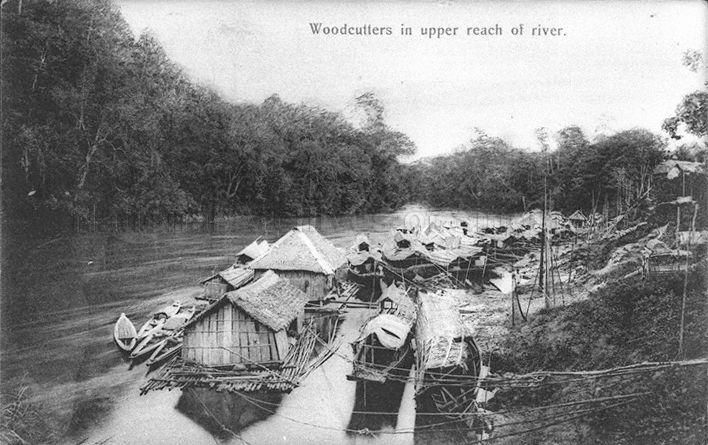
Orang Seletar along Sungei Seletar. Taken from: National Archives of Singapore

Though it was said that the life on boat these boats were nothing but difficult. Staying close to the rivers meant that the dwellers would have to contend with mosquitoes and other irritants.

A View of Sungei Seletar looking out towards Malaysia
To find out more about the Orang Seletar, do check out this brilliantly written paper by Mariam Ali.

February 4, 2015 update:

In John Maksic's book called "Singapore & the silk road of the sea", he summarised in English, the Sejarah Melayu or the Malay Annals. In the Annals, it mentioned how the last Sultan of Singapura - Iskandar Syah, escaped from the island after the Majapahit Empire had defeated him. Sultan Iskandar Syah "fled to Seletar, then Muar" and after two years, settled in Melaka in the early 1400s. (2) 

Why did Sultan Iskandar escapeed through Seletar? My take is that the Orang Seletar were already there and they might have helped him to escape the Javanese. Also, there might have already been an established path that led the Sultan from Bukit Larangan (Current Fort Canning) to Seletar. The Orang Laut had previously helped Sultan Iskandar to escape from Palembang to Singapura too. (2)
 

References:

1. C, Chou (2010). The Orang Suku Laut of Riau, Indonesia. Routledge: United Kingdom.
M, Ali. (2002). Singapore's Orang Seletar, Orang Kallang and Orang Selat. Institute of Southeast Asian Studies: Singapore.

2. Miksic, J. (2014). Singapore & the silk road of the sea. NUS Press: Singapore. PP153, 156.

Saturday, July 19, 2014

[Singapore Islands] Sultan Shoal Lighthouse

Frontage of Sultan Shoal

Sultan Shoal is one of the smaller islands of Singapore. (1) Standing on the island is a lighthouse that was built in 1895, a chalet for Maritime Port of Authority staff, and a swimming lagoon. One of the first mention of Sultan Shoal was in the newspaper in 1863. It was about a steamer Behar that was captained by Captain Dundas. The steamer was suppose to be anchored off Sultan Shoal but the captain chose to proceed to the harbour so that there were more time to "transact business". (2) There was a by-mention of the Shoal in the newspapers in 1852. (22)

The Sultan Shoal was a dangerous area for ship as they were still running aground. One example was seen in 1869 where a British government steam launch Mata Mata sustained damage as it ran aground. (3) This was even after the government had erected a stone beacon in 1865 prior to the  building of the lighthouse. (4) (5)

Source: Google Maps

With the ongoing reclamation, the Sultan Shoal is now pretty much enclosed in an area between Tuas and Jurong Island.


Here're ten interesting facts about the Sultan Shoal


Singapore stamp of 1982. Source: Lighthouse stamp society. (17)

1. The granite stones used to build the lighthouse actually came from the quarries of Pulau Ubin. (6) 

2. In 1928, Sultan Shoal was used as a drop-zone for opium smugglers. Two buoys were thrown overboard with each attached with a bundle of opium (Chandu). Three Chinese men were arrested and charged with the "importation of non-government chandu"(Yes, opium was legally grown in Singapore) (7)

3. The light keeper used to keep "two loaded rifles, with fixed bayonets, and three swords" for keeping away pirates. (8)

4. By 1939, the British government had started to place mines in the waters around Singapore. A warning was post in the newspapers warning mariners of "dangerous obstructions" being laid from Tanjong Piai to the Sultan Shoal. (9)  During the early days of the Japanese Occupation in 1942, everything movable on Sultan Shoal were taken away. But prior to this loot, the lighthouse keeper was alert enough to hide all the vital lighthouse equipment away in hard-to-find places such as water tanks and secret storages. (10) Interestingly, most of the lighthouse keepers during this time were Eurasian and during the Japanese Occupation, the Sultan Shoal Lighthouse was taken cared of by Matthew Cunico. (11)  Mr Cunico received the King's Commendation for Brave Conduct "in services rendered towards effecting the escape of Brig. A.E. Cumming V.C. (Brigadier Arthur Edward Cumming) and eleven other officers in February 1942". (21)

5. Workers at the lighthouse generally do not have contact with the outside world. Not until the installation of the first talkie sets. (12)  It was only in 1963 that the lighthouse keepers were provided with television sets. (14)

6. The British Troopship - "Empress of Asia" sunk after she was bombed by the Japanese in January 1942. It was located 1/2 a mile East from Sultan Shoal. (13) She was finally salvaged in 1960. (16)

7. Indonesian gunboats had been attacking sampans and other boats just off the waters of Sultan Shoal. Some of these attacks left a number of mariners injured. (15)

8. Drama around the Sultan Shoal prior to the fall of Singapore in 1942. The 30,000 ton troopship HMS Empress of Asia, bringing 2,000 troops from India, was sunk by Japanese dive-bombers off Sultan Shoal. Eyewitnesses said that "thousands of people were seen bobbing in the water making desperate attempts to swim away from the blazing ship". (16) A former lighthouse watchman, Mr Felix Paul Monteiro, said that he saw the attack while being based on Raffles Lighthouse. The surviving soldiers then swam to Sultan Shoal. Artifacts from the wreck were brought to the surface in 1998 by a commercial diving company and these items were donated to the Singapore History Museum. (18) 

9. The lighthouse was converted to an unmanned fully automated lighthouse at a cost of S$500,000 in 1984. Previously, the lighthouse was manned by four lighthouse keepers. (19)

10. Sultan Shoal has more than 2,800 hard coral colonies. To save these coral from destruction due to passing ships, part of it have been relocated to nearby Sisters' Island and St. Johns Island. (20)


References

1. http://lkcnhm.nus.edu.sg/dna/places/details/58
2. Untitled. July 4, 1863. The Straits Times. P2.
3. News of the week. December 18, 1869. The Straits Times. P2.
4. Untitled. May 29, 1875. The Straits Times. P3.
5. The Sultan Shoal Lighthouse. February 24, 1876. The Straits times. P2.
6. Untitled. July 18, 1894. The Straits Times. P2.
7. Revenue Officers Catch Chinese Smugglers. July 28, 1926. The Straits Times. P9.
8. Lonely keepers of Sultan Shoal. March 6, 1938. The Straits Times. P17.
9. Obstructions in Singapore Waters. September 4, 1939. The Straits Times. P11.
10. Local Lighthouse Shines Again. March 31, 1946. The Straits Times. P2.
11. Modder, M. June 27, 1948. Singapore Watchmen of the Sea. The Straits Times. P6.
12. Radio link for colony 'lights'. July 31, 1951. The Straits Times. P7.
13. Ship sunk in war to be raised. February 23, 1952. The Straits Times. P7.
14. Lonely lighthouse men: TV helps pass time. March 28, 1963. The Straits Times. P11.
15. RI Gunboat fires at bumboat: One hurt. December 14, 1966. The Straits Times. P24.
16. Daniel, J. December 1, 1974. How eleven ships met their doom off Singapore. The Straits Times. P11.
17. Lighthouse Stamp Society. Accessed on March 20, 2016. http://lighthousestampsociety.org/wp/images-2/stamps/stamps-countries-s-t/stamps-singapore/

18. Cheng, A. L. July 23, 1998. Ship's "Treasures" found off Tuas. The Straits Times.
19. PSA lighthouse goes to go automatic. December 30, 1983. The Straits Times. P11.
20. Relocating corals at Sultan Shoal. April 26, 2014. The Straits Times.
21. Awards and Citations. June 11, 1948. Morning Tribune. P14.
22. Singapore Free Press and Mercantile Advertiser. April 23, 1852. P2.

Updated on November 18, 2018.
Additional information about Brigadier Cumming shared by Mr Richard from Marine Heritage Interest Group (SMHIG).


Further reading

Read about how the Sultan Shoal Lighthouse was first built in 1895.

A good story about Sultan Shoal's light keeper of 1937 - Mr. Adolph Monterio and his staff of five

An interview with a former sailor of Empress of Asia troop carrier that sank off the waters of Sultan Shoal.

Website dedicated to the British Ship - Empress of Asia.

Tuesday, July 1, 2014

[Military] Steel Pot Warriors

My fellow recruits and I were super elated to have completed our field training

The Singapore Armed Forces started issuing Kevlar helmet from January 1987 onwards. (1) But when you are a recruit, you will never get the best of anything. Actually, you will get all the remaining army stores. So instead of getting those lightweight Kevlar helmets, the recruits received what the army termed as steel pots. Thinking back, I am glad that we had a chance to own those Vietnam War-like steel pots. To add on to that Vietnam War aura, we were issued with well-worn M16s rifles.

Now back to our steel pots. 

Though it made good memories, these steel helmets were the bane of soldiers. Looking back at all the recruit photos that I'd taken, none of them saw me wearing my helmet. Why?

It was heeeaaavy! It was so heavy that a pioneer soldier of 1967 counted his lucky stars as he was a Sikh and was exempted from wearing the steel helmet. (2)

"The old steel pot helmets were very uncomfortable! In a way I was very lucky because I was wearing a turban! You know, I think their helmets were heavier than my turban! You could actually hear them go 'clang'!" (2)


http://www.mindef.gov.sg/content/dam/imindef_media_library/photos/army/army_museum/0114.res?direct=1
Source: Army Museum Singapore

The helmet consisted of three parts. One was the plastic inner layer that you wear under your steel helmet, and the other part was the steel helmet itself. The third part was the camouflage cloth. We had to use a thick black rubber band to hold it in its place. The rubber band was also used to slot in leaves and ferns when we were learning how to camouflage ourselves.

For recruits, there were something more that we had to include on our helmets. When we inherited these steel pots on Day 1, we were told to write our names on masking tapes using a black marker and stencils. Once that was done, we had to waterproof it using transparent sticky tape. I was not allowed to use my Christian name, only my initials and my surname, which read W. A. Phuah or in hokkien lingo "I'm Phuah". These initials and surname thingy really embarrassed some people, especially the Chinese. We had K. A. Chng (Bottoms), S.H. Chong (Taxi Chong as taxis' number plates start with SH) and A. H. Lee (Ali).     

The worst time to have these helmets on were in the afternoons with the sun in full glory, and during our Standard Obstacle Course (SOC) where we were asked to do a 50m run, clear eight obstacles, and then complete the entire SOC with a 600m run. Running caused our helmets to wobble back and forth and that caused us great discomfort.

My Buddy and I zoning out after completing our SOC
We were also required to wear our helmets when we were digging our little trenches or what is known as shell scrape. I remember a funny incident where we were told by our sergeant to dig a shell scrape. He gave us an hour to complete our digging. After 30 minutes of digging, and with the helmets giving us grief, I told my buddy that I'll be taking off my steel pot and will just wear the helmet liner. He said in hokkien, " Mai Xiao Lah" or "Don't be crazy". I replied," Nevermind lah, Sergeant not here mah", not knowing that Sergeant Rajah had somehow ghosted into our vicinity and he was just standing behind me. Let just say that the punishment I'd received included running around like a mad man, and strengthening my arm power with countless push ups.

So as a tribute to all soldiers past and present, whether it was steel pot or Kevlar helmets, thank you for your dedication and for protecting our homeland. Have a good SAF Day.

Training to be soldiers, fight for our land
Once in our life, two years of our time.
Have you ever wondered, why we must serve
Because we love our land, and want it to be free, to be free. 


References

1. Cyber Pioneer Issue 109 (Nov 1986).
2. Army Museum Singapore. Retrieved on July 1, 2014. http://www.mindef.gov.sg/imindef/mindef_websites/atozlistings/army/microsites/armymuseum/stories/Personal_Stories/The_Swinging_60s/Karam_Singh.html


Other references
1. Remember Singapore. Once in our life. Retrieved on July 1, 2014. http://remembersingapore.wordpress.com/2013/05/01/once-in-our-life-two-years-of-our-time/

2. Run-down of the SOC Course. Retrieved on July 1, 2014. http://www.youtube.com/watch?v=91xC-JiiudM

Sunday, June 29, 2014

The Playground of the Orang Laut


Facing the Mangroves

Mangrove forests and urban development can hardly co-exist. In the 1820s, mangrove forest made up of about 13% of the total land area. In the 1990s, it was down to about 0.5%. (1)

Mangrove forests can now be found in small patches around the north and northeast of Singapore, and on islands such as Pulau Ubin, Pulau Tekong and Pulau Semakau. (1)

The biggest mangrove forest is the 130-hactre Sungei Buloh Wetland Reserve. (2)

There are great positives in maintaining these Mangrove forest. For Sungei Buloh, it is listed as a forest that sees a good level of biodiversity - birds, fishes, etc. The mangrove also help to stabilize the land closest to the sea. (3)
Source: National Archives of Singapore

The Orang Laut (People of the Sea) in Singapore such as the Orang Seletar and Orang Galang would have been closely acquainted to the mangrove forest as they made the river mouths their home. This was where they would get their fishes, fruits and timber. (4)

I had hoped that I could get a taste of what being an Orang Laut is like when I headed north to the town of Kukup, Malaysia

The flight distance from Tuas to Pulau Kukup is 26 kilometres (KM), and a driving distance of 69KM. So it's pretty close to Singapore. To get to Pulau Kukup, you must first set off from Kukup town. It is about 10 minutes boat ride before reaching the island's jetty. An entrance fee was required (RM10) and after which, you can enjoy the serenity of the mangrove forest.
Pulau Kukup Jetty
The development of the island serves as a boon for visitors. Modernity brings to us boardwalk, bridges and watch towers where one can observe nature up close without needing to get one's feet dirtied.  

We were greeted by monkeys. These 'residents' of Pulau Kukup were curious of our presence. As the day we visited the island was a weekday, only my colleagues and I were there. 

We arrived at our first climb - a suspension bridge. The "one-lane" bridge hung over Sungai Ular or snake river, one of the five rivers that meanders inwards through the island.

The bridge is wide enough for only one person to pass
In truth, the entire island was pretty huge and we had seen only a stretch of Sungai Ular. That afternoon, the water was coffee brown and everything looked still.

View of Sungai Ular

Moving further inland, the ground turned muddy. Inversely, such muddy grounds are appreciated by mud skippers and snails.  This is the world as it was when the Orang Lauts ruled the rivers. What I love about this weekday trip is the tranquility of the island and all i heard were noises from animals and the rustling of leaves!

The snails were seen in many locations at Pulau Kukup

Reference:

1. http://mangrove.nus.edu.sg/guidebooks/text/1003.htm
2. http://www.nparks.gov.sg/cms/docs/Sungei_Buloh_Wetland_Reserve_eGuide_LRes.pdf
3. http://wwf.panda.org/about_our_earth/blue_planet/coasts/mangroves/mangrove_importance/
4. Florida Museum of Natural History. (Retrieved on June 29, 2014).  http://www.flmnh.ufl.edu/fish/southflorida/mangrove/importance.html

Monday, June 23, 2014

[Historical Site] WWII: Ford Motor Factory

A Japanese bayonet and cap as seen on display at the Ford Factory Museum
A bayonet and a cap sat quietly in a showcase. These items are more than 70 years old but they still strike fear in the hearts of those who have lived through those times. A bayonet, when affixed onto a rifle, was a harbinger of pain. Extinguishing lives before their due. While the cap shades the Japanese soldier from the sun, it also adds on to the fearsome demeanour of the Japanese soldier.

Both these items and more are currently being kept in the Old Memories at Ford Factory Museum along Upper Bukit Timah.  

Frontage of the old Ford Factory
History of the Ford Factory in Singapore

The factory's assembly plant was already running in July 1941 and the cost of the entire set-up came up to $1,000,000. (1) The British government was using this plant to build military vehicles and trucks for use in the war against the axis powers. The Singapore-based plant had also provided a source of income for more than 400 workers.

Photo of Ford Motor Company taken in 1942. Source: National Archives of Singapore

The Surrender Papers
 
This factory was also an important landmark as it was where the fate of Singapore was decided on 15 February 1942. After just eight days of fighting on local soil, Lieutenant-General Arthur Ernest Percival had no choice but to surrender as the island was running out of food, water and ammunition.

More lives would have been lost if Percival had chosen to fight on. He was then asked by the Japanese Imperial Army to surrender unconditionally at the Ford Factory, which the Japanese has made it their Imperial Army Headquarters. Victory was on the faces of Lieutenant-General Tomoyuki Yamashita and his staff, while Percival and his men looked forlorn. Both parties walked into the room location at the far left of the factory.

Lt. Gen Yamashita demanded the surrender of the British-led forces. Source: National Archives of Singapore 

Significance of the Table, Chairs and Clock

The dark wooden oak table was of great monumental significance as it saw the pounding of Yamashita's fist on it to demand that the British surrender immediately. It also held up the surrender papers that Lt. Gen Percival signed. The chairs that were used by both the British and Japanese to sign the surrender papers must have felt the strain with the unfurling of such an important event.

Miraculously, all these items survived the war and are now on display in the Old Memories at Ford Factory Museum. Symbolically, the timing on the wall clock shows that it is 6:20 - the exact time that Percival signed over British control of Singapore to the Japanese.

Original table and chairs used in the signing of the surrender documents

Grand Story Teller

To see if we can learn more about this historical place, my colleagues and I made a trip down to the Old Ford Factory. We met a museum staff, Mr Leung Keng Hong. Though he claimed that he was not an official guide, he was extremely kind to have brought us through the exhibits. He gave a very balanced view about why Percival needed to surrender and that war should be avoided at all cost.

Mr Leung in front of the Peace Sculpture


Nugget of Information

Through our entire tour, Mr Leung shared many interesting points which helped to give life to those artifacts that have been silenced for so many years. The tree trunk that was placed in the museum to which he said that the people were so hungry that they stripped the tree of their barks for food. Also, POWs crushed the lalang to extract starch and sugar for their survival.

One interesting point that Mr Leung had raised was that there was a railway track that ran behind the Ford factory. I further quizzed Mr Leung but he could not shed much light to this railway track.

If there was really a railway track at the back of the factory, where could it have been located?


References

1. The Singapore Free Press and Mercantile Advertiser (1884-1942). 12 July 1941.
Military Trucks Run Off Assembly Line In Malaya. Page 7

Wednesday, June 11, 2014

Yin Fo Fui Kun (应和会馆) Cemetery and Ancestral Hall


The new and the old buildings co-exist for now

Cemeteries and ancestral halls are becoming places of the past in land scarce Singapore. It is claimed that the mosaic-clad tombstones that have been sited at Holland Close since 1969, will be cleared so as to release space "for buildings such as a cultural and social hall" (Zaccheus, June, 8 2014).

My interest of this place lies with the fact that there sits a historical building that was built in 1887. If the tombstones were to be taken away, I want to know if this old building will still be maintained.

So I had to pay a visit to the ancestral hall to hear from the people who manage the land.

Symmetrically-lined tombstones that were erected in 1969

I remember the first time that I caught sight of this cemetery was some 20 years ago when I visited a friend. He was staying at Holland Village and his flat was overlooking the cemetery. He offered me a simple narrative about the cemetery - that it was pretty old and that residents there were not afraid of any spiritual happenings nor has he seen anything unnatural. Funny how we always ask whether those residents have came across spirits whenever we are next to a cemetery. Many a times, they will proffer their stories as if they knew that we were going to ask them about it anyway.

This was also the case when we spoke to the caretaker of the ancestral hall, Mr Tan (陈先生). But let us first focus on the issue on hand. What is this place and whether will the tombstones be removed.


The start of our journey

My colleagues and I walked through the cemetery and were looking at the different tombstones. The sun was shining bright and we were there at about 10:30am. Still, the heat could not dissolve our quest for the truth. We stopped at the different tombstones to read the nicely written inscriptions. Some of which have been carved in stone. There were the 李,黄,陈 and many other different surnames listed. Some of these tombstones had little stones placed on top of them. This was to signify that someone had paid the grave a visit and that they are being tended to.

We also realised that nearly all of the tombstones listed their burial year as 1969. We were curious to find out why.

In a short distance stood a gardener. He was an unassuming and friendly chap who gave me a big smile and was waving at me to come towards him.

The story behind the tombstones

Row after row of mosaic-clad headstones greet visitors of this cemetery

The gardener was tan and his face was weather-beaten. The features just adds on to the authenticity of what he was about to share with us. He spoke totally in Hokkien and some parts of which, I could not really understand as he was putting in certain names of places, or older activities practiced in times gone by.

He shared about how he has tended the cemetery ever since 1983 and that he was the second generation of gardener. He took over the role of tending the cemetery after his father passed on. He shared about how the Hakka community had purchased a big piece of land from the government. Written records showed that they had purchased 40ha of land in 1887. He said that the land stretched all the way to a site where a current school sits. I'm not too sure which school, but I gather it must be either the current CHIJ St. Theresa Convent or Queensway Secondary School. Most of the land have been acquired by the government by the 1960s for re-development. He said that there were also graves where Blk 7, Holland now sits. They have now all been moved to this cemetery.


The caretaker of 双龙山

I walked over to the ancient ancestral hall. We did not know what to expect and whether we needed to remove our shoes as a sign of respect. So we stood at the entrance and had a full view of the wooden tablets before us.

Tablets at the Ancestral Hall


A gentleman in a well-worn shirt and dark pants, and shoes that were held together by green rafia strings, glided past us. He then cast a look at us and with a waving movement of his hands, invited us into the ancestral hall. Somehow mesmerized, I followed him towards the right side of the hall. He stopped. I stopped. Only to realised that I was suddenly surrounded by hundreds of yellow porcelain urns that came in different shapes and sizes.

I had also noticed that two workers were busily removing pieces of wood. To break the ice, I asked this gentleman what was happening here. He said that they were doing some restoration work as the termites had eaten through the wood that was holding up the ceiling. They have to move the urns so that work could be done.

Only then did he introduced himself as 陈先生 (Mr Tan) and that he has been the caretaker for over 30 years. This was when he started to share with us his many stories - some historical, other spiritual to a point of ghostly.

Within the Ancestral Hall

He said that in the ancestral hall, he has collected urns and tablets that are not only from the Chinese Hakka community, but also Indians and foreigners such as Hong Kong residents. 陈先生 also made mention of a couple whose bodies laid behind the tablets and that their bodies had remained in a well preserved state.

Entrance to the historical Ancestral Hall
We then moved towards the entrance to which he turned to look at the altar. He pointed to the signboard and also the red pillars and said that all these wood actually came from Malacca. He gave me the names of the types of wood used, but I can hardly make out the different types of wood if I was given their English names, more so when he rattled off the names in Mandarin.
He had also shared that the ancestral hall was used as a school.

We have spoken quite a bit by now and I thought that here was my chance to go for the jugular. I meekly asked Mr Tan whether the news report about the removal of the tombstones was true - That the Association was going to build a pagoda to house these urns. You could just hear the irritation in his voice. "No way, No way! I do not know why it was reported as such". He then added, "我们是不会封山的” meaning we will never seal off the place. 

The place that's called Double Dragon Hill (双龙山)

I did not want to agitate the poor man further. So I asked him why was this place called "双龙山”. The frown lines slowly disappeared and started to share about the past, saying that there were two hills. One was in front of the ancestral hall, and the other was slightly to the back. 

I asked if there were many Dutch families staying in this area since it's called Holland Village. He simply replied, "No, mostly Hakka people lived here".

And here's the hook...

I was not ready to ask him anything that he was not comfortable to answer and the questions that I have were already well and truly answered. We were moving towards the doorway when he turned around and said, "I see three people playing mahjong". I interjected,"Now? You mean where we are now standing?"

"There are times. Just at the doorway". I shifted myself away from the doorway.

"Come, follow me", Mr Tan beckoned. "Let me show you the room of the former caretaker".

The caretaker's room that looks towards the entrance door on left wing of the hall

Not sure of what was to expect, I followed him and to ensure that I kept myself alive, I made sure there was a little bit of distance between us just in case I got dragged into something that I did not want to be a participant in. He continued with his story saying that the former caretaker had a very bad dream and was told that something untowards would happen to him. Shortly after, the caretaker was found dead in his room.

This was when Mr Tan opened the door to the room and thank goodness, we saw just ladders and other tools and nothing else. So it has been converted to a storeroom.

By now, Mr Tan had spent more than 30 minutes with us and as abrupt as we first met him at the ancestral hall, he ended the tour with " 我要回去做工了” (I need to get back to work).

Still, the entire experience was totally enriching. The gardener and the caretaker really took time off their work to chat with us. Today, we have learnt much about the Chinese culture and also history of Singapore. 

My colleague, Michael who was with me during this visit, aptly closed this visit by saying, "It was interesting seeing this remnant of old Singapore juxtaposed with the new, with the HDB flats in the background. The caretakers were so approachable and generous with their time and easy manner, reminding me of what Singapore was like back in our kampong days and leaving me somewhat wistful."

Good read/ References  

1. Zaccheus, M. (June 6, 2014). Hakka tombstones may have to go. Straits Times. http://www.straitstimes.com/news/singapore/more-singapore-stories/story/hakka-tombstones-may-have-go-20140608
2. Wong, D. (November 30, 2012). An oddly-placed cemetery. Poskod.sg. http://poskod.sg/Posts/2012/11/30/An-Oddly-placed-Cemetery
3. The Hakka Story. Retrieved on June 14, 2014. http://www.youtube.com/watch?v=j2cRR3nhRhI

Saturday, June 7, 2014

Starting Afresh

http://hippies.com/wp-content/uploads/tiedye-tapestry.jpg


The history of Singapore - The Ministry of Education are now looking to incorporate history lessons that goes back centuries, way before Sir Stamford Raffles. Singapore's history did not start in 1819. Our documented history goes as far back as the 14th century. There is really so much to discover about Singapore.

We have to learn from the past to equip ourselves for the future.

So I'm starting afresh with this blog. I'll dedicate my writings to my Singapore exploration. I'll focus on historical sites that I've visited; the disappearing landscapes; and other historical research that I'm doing.

I want to find out more about the Singapore I live in and I will like you to join me in this exploration. So do share your story - let's build the story of Singapore together.