Showing posts with label Japanese. Show all posts

Saturday, November 30, 2019

[Demolished Buildings] Government Printing Office

1993 map showing the Singapore National Printers Ltd. - Department of Geography
The building was formerly known as the Government Printing Office till 1973 - Department of Geography
Photo of The former Government Printing Office taken by Mr Lee Kip Lin - National Library Board

The Government Printing Office was first established in 1867. (National Archives of Singapore, 2018) The office was first located in High Street before relocating to the Upper Serangoon Road building in the 1930s. 

Every important document that the government had needed (From annual reports to secret reports) to use were printed in this building.

"It functioned as the Singapore Government's central organization responsible for all printing work from Government Gazettes, Bills, Ordinances, School and Government examination papers and syllabuses, directories, departmental annual reports, Legislative Assembly debates, statistical publications, scientific works, official forms, revenue receipts, account books, registers, to invitation cards, publicity posters, booklets and pamphlets." (National Archives of Singapore, 2018)

It is also said that during the Japanese Occupation, the Japanese took over the building to meet their own printing needs. (National Archives of Singapore, 2018)

The building continued to be used after the war "until 1 April 1973, when it became a private printing company and subsequently renamed as Singapore National Printers (Pte) Ltd." (National Archives of Singapore, 2018)

The first two directors of the company were Mr Kwa Soon Chuan and Ms Julia Yeow Geok Imm, both of whom were civil servants. (National Archive of Singapore)

The present company is now called Toppan Security Printing Pte Ltd. (Toppan, 2019)
 

Questions: 
- Why did the government choose to locate the office at Upper Serangoon Road? 
- During the Japanese Occupation, which department took charge of the printing office?


References

Department of Geography. 2016. Singapore Then & Now.  https://www.nusgis.com/thenandnow/. National University of Singapore. Retrieved on November 30, 2019.   


National Archive of Singapore. 2018.  https://www.nas.gov.sg/archivesonline/government_records/agency-details/121. Retrieved on November 30, 2019.

National Library Board. 2009. Government Printing Office. https://eresources.nlb.gov.sg/pictures/details/6db365a1-7845-4cdb-8fc4-437d5756e012. Retrieved on November 30, 2019. 
 
Singapore National Printers Pte Ltd Agenda & Minutes of Directors' Meeting.
National Archive of Singapore.
https://www.nas.gov.sg/archivesonline/government_records/record-details/23ce225d-11ca-11e8-a2a9-001a4a5ba61b. Retrieved on November 30, 2019.  

Toppan. 2019. https://www.toppan.com/en/location/singapore/. Retrieved on November 30, 2019.

Sunday, August 16, 2015

[Singapore Parks] Mount Emily Park

Signboard of Mount Emily Park
There are more than 300 parks and 4 nature reserves that come under the charge of Singapore's Statutory Board, NParks. Indeed, some parks are less well frequented than others. This can be due to their locality, its facilities or the variety of activities that are organised within the park.

Mount Emily Park is pretty much a quiet old dame of a park that offers nothing more than serenity. Surrounded by private housing, St. Margaret Primary School and the Istana grounds, the park sits on an elevation far beyond the noise of any vehicular movements. Even though the park itself is within the Central Business District.

Behind its quiet facade, the park grounds hold rich history of Singapore's past. Mount Emily was previously known as Bukit Rawa. 

Closer look at the Coat-of-Arms

One of the first structures that you will see at the park is this entrance shelter. Sited in the rock wall of this structure is an emblem of yesteryear. This emblem is a coat of arms granted to the Municipal Commission by the College of Heralds in April 1948. (1)  The colours featured on the coat-of-arms are largely intact and it's such a throwback to see this in person.

Singapore's Coat-of-Arms


It is said that this was the entrance to the former Mt. Emily Swimming Pool. This is where the part about it having a rich history begins.


Reservoir and Mount Emily Swimming Pool

Mt. Emily Reservoir (2)
Mt. Emily once held two service reservoirs that were constructed in the 1880s. But by the late 1920s, the service reservoir was no longer required. It's redundancy was brought upon by the building of the Fort Canning Service Reservoir, which the press claimed to be the largest enclosed reservoir in the East. (3)   

1954 Map from OneMap (4)

The reservoir was then converted into a swimming pool and it was officially opened by Mr R. J. Farrer, President of the Municipal Commissioners on January 10, 1931. (5) The total cost of converting the reservoir into a public swimming pool came up to $30,000. (6) To find out more about Mount Emily Swimming Pool, click here. (7)


Mount Emily Park

Panoramic view of the park


In the early 1900s, Mount Emily Park was seen as a popular retreat of those staying close by. There was a band that played in the afternoon. Parents and children would also spend time playing together. (6)  

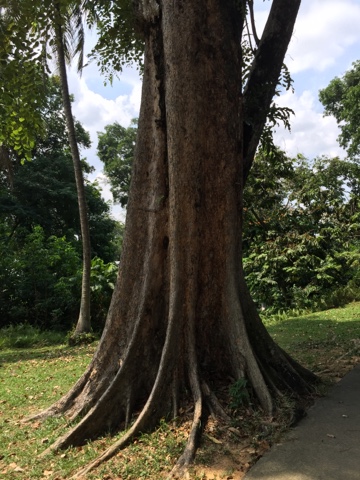
Some of the oldest trees seen in the park
The girth of some of the trees there stood as testament of its glorious days. The age of these trees must have been more than 100 years old.

With such a rich history to this park, surely it must be made into a place of interest for local Singaporeans.


Last updated: August 19, 2015


References


1. Lim, J. November 7, 2014. A crestfallen ghost of the past. The Long and Winding Road. Accessed on August 16, 2015. https://thelongnwindingroad.wordpress.com/tag/singapore-municipal-commission/ 

2. National Archive of Singapore. Accessed on August 16, 2015.  http://www.nas.gov.sg/archivesonline/photographs/record-details/ae41408a-1161-11e3-83d5-0050568939ad

3. The Singapore Free Press & Mercantile Advertiser. September 17, 1929. New Emily Park. P9.

4. OneMap. Accessed on August 16, 2015. http://www.onemap.sg/index.html

5. The Singapore Free Press & Mercantile Advertiser. January 1, 1931. Mount Emily. P20.

6. The Singapore Free Press & Mercantile Advertiser. January 12, 1931. A Big Splash. P20.

7. Mount Emily Swimming Pool. December 20, 2012. Accessed on August 16, 2015. http://rememberingsingapore.blogspot.sg/2012/12/mount-emily-swimming-pool.html


Sunday, August 2, 2015

[Singapore Parks] Punggol Point: Watching the Sunrise


A Refurbished Punggol Point

Sunrise at 7:08am

Sunrise at 7:11am

Punngol Point Jetty
Interesting rock formation found along the beach

Puggol Beach taken from the look-out

The Look-Out Point


Fish Ponds Along the Promenade

Playground for the Kids

Sunday, February 8, 2015

Battle for Singapore Heritage Tours: Adam Park


This year marks the 73rd Anniversary of the fall of Singapore. In February 1942, bloody battles were fought on all sides of Singapore. Through the various tours organised by Singapore's National Heritage Board (NHB), I had the opportunity to re-live some of these battles, starting with the Adam Park Tour led by the very animated and energetic Mr Jon Cooper, curator at the Changi Museum and founder of the Adam Park Project.


Jon had so many stories to tell that the entire tour truly came alive! We stopped at various houses of interest. The first bungalow we stopped at was a very prominent one - 7, Adam Park. Facing Adam Road, the bungalow was used as a British Command Centre. The 1st Battalion Cambridgeshire Regiment 18th Division was tasked to prevent the Japanese advancement. 

It was said that the Cambridgeshire fought with true distinction. Arriving in Singapore only on January 29, 1942, the soldiers led by Lieutenant Colonel G. G. Carpenter, took up their defence around Adam Park on February 12, 1942. (1) Shortly after, the British soldiers came face-to-face with the Japanese opponents. The Cambridgeshire lost little ground in the ensuing battle and was said to be "the last to cease fire when Singapore surrendered". (1) 

Jon, being an Archeologist, was able to pick up a large amount of British empty cartridges at 8, Adam Park. It was believed that the Cambridgeshire sand-bagged the base of the house and pointed their weapons towards the road. It must have been a fierce firefight between the two forces at Adam Road.


We were then brought to 19 and 20 Adam Park. It was said that a bloody battle was fought between these two bungalows. The British had occupied 19 Adam Park in the night. With 20 Adam Park unoccupied, the Japanese moved into it and by the morning, all of them had new neighbours. Both sides used whatever weapons they had to try and dislodge each other. After a good fight, the British finally forced the Japanese soldiers out of 20 Adam Park.


The house at the end of the road - 16 Adam Park. This property has its own golf course and that was where the Japanese had put in a sneak attack too. The fight was taken on the lawn of this bungalow.


When the British surrendered, the entire Adam Park was turned into a Prisoner-of-War (POWs) camp. As the POWs were locked in, they created their own chapel. Jon deduced that through his research and studying of aerial maps, the likelihood of where the chapel was located seems to point towards 11 Adam Park. There was even a canteen on the ground level of the bungalow that was managed by a folks.

This was indeed a very good tour of Adam Park; led by a very good guide in Jon; and at a very good time - in the lead-up to the commemoration of fall of Singapore on 15 Feb 1942.


References

1.  Afflerbach, H., Strachan, H. (Eds). 2012. How Fighting Ends: A History of Surrender. Oxford University Press: Great Britain.

2. Regiment Gets Freedom. October 16, 1946. The Singapore Free Press. P3.


Friday, September 12, 2014

[Park] Sembawang Park: A view of Sembawang Shipyard


I had intended to start my round of cycling at Sembawang Park and head south. But I ended up cycling all around the park instead. 


Hand to heart, I was totally mesmerised by the place. I arrived at the park pretty close to dusk and was in two minds whether to continue with my cycling expedition as it was drizzling. I was thankful that I proceeded as planned as I rediscovered the charms of Sembawang. I'd spent part of my life in this area as I was from the Boys' Brigade and their campsite was just around the corner. That's another story for another day. The park itself is not well visited and thus totally serene.


On top of that, the after-rain air was refreshing. I even tried to take in an extra breath or two to shake my lungs to life! Located in that area are barbecue pits and rest shelters. There is also a jetty where anglers launched their line in hope of catching substantial amount of fish. Others were social anglers who were there to socialise with their other angler friends.


Just to the left of the jetty sits Sembawang Shipyard which was formerly the mighty Sembawang Naval Base - a crown jewel to "The Gibaltar of the East".


Thursday, October 23, 2008

Quaint Japanese Restaurant in the Park


I was at first put off with the sign even though it was shouting out to me, "sushi for 99 cents!". What gimmick is this? I asked my wife.

But lo and behold, we found ourselves in that restaurant still. Why? For the sheer reason of being too lazy to search for another restaurant.

We were shown to our table and even before we warmed our seats, we were told that we had to head to the outside to pick our food. What happened to the tried and tested menu at the table?
Outside, we walked like 100 metres to pick our food. Ok, that's exaggeration! But you make a diner walk for their food, and then, we still have to fork out 10% for service charge? That's totally unpalatable!

So what helped to calm my jittery nerve of expecting the worst? Well, the food did come and I can say that the yakiniku beef ramen was delicious. The sashimi was also pretty fresh, though it could have been sliced a little more thinly. But having it thickly-sliced means it's value for money right? I'm such a cheapo!? But truly, it'll be much easier on the mouth if the slices are thinner.

The sushi, though was pretty attractive with row after row of coloured plates moving around the sushi train. What's more, it's 99 cents! Great draw for a hungry hippo like myself.

A point to note for the management, please don't make us walk for our food, unless your sole intention is to make us hungry again so that we can go for another round.