So much has changed from the old Potong Pasir days. was said to have good soil for growing vegetables. Gone are the vegetable farms that were strewn across the land. But did you know that farmers had tilled the Potong Pasir land since the 1850s. The land had also produced the country's best vegetables. Vegetables that once fed 50 percent of Singapore's population. That was how important home-grown vegetables were to us, Singaporeans.
Showing posts with label Vanishing Trade. Show all posts
Monday, June 21, 2021
Sunday, October 23, 2016
[Vanishing Trade] The Mamak Shop along Jln Todak
![]() |
| Mr Majid standing proudly in front of his mamak store |
The owner did not seemed too bothered whether there was business or not. In the 30 minutes that I'd observed the shop from the opposite coffeeshop. He sold just two packs of cigarettes and in between, he'd just plonked himself down on a plastic chair, looking out towards nothingness.
![]() |
| Looking out towards Lorong Todak |
The ice was broken and this was the opportunity for me to have a closer look at his wares and at the same time, find out more about this interesting mamak shop.
![]() |
| Cigarettes, cigarette paper, lighters, lighter fuel |
Looking at what Mr Majid has at his hole-in-the-wall shop, there were really nothing that interest me, actually. It's cigarettes, cigarettes and more cigarettes.
Though I did not buy anything from this veteran owner, he was still more than willing to talk about the nostalgic past. He claimed that he has been running this Mamak Shop for about 45 years. The building in which the mamak shop is located was said to be built in He's kept the shop opened 365 days a year. In his heydays, his shop used to span about twice its current length and to manage the shop, he used to employ four others, including his brother.
Mr Majid also mentioned that he indeed, sold more items in the past. But now, he has cut down on the items that he's selling. Business was booming in the past as there were popular coffeeshops and a market nearby.
Sunday, September 18, 2016
[Food] Blk 644 Hougang Mee Chian Kueh
![]() |
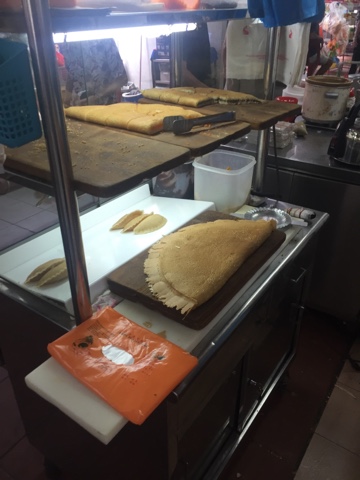
| Freshly-Made Bee Chiang Kueh |
People live and die for food. People will also defend the origins of some of these food and this peanut pancake is something that some countries in Southeast Asia and even Taiwan lay claim to.
The Chinese name it 面煎粿 (Mee Chian Kueh or Min Chiang Kueh) or Apam Balik in Malay. Though the name may be similar, the end product differ from country to country.
Peanut-filled, the traditional ones that we see in Singapore are fluffier. Seasoned opposition leader Mr Chiam See Tong is said to be a lover of this tasty snack. (1)
The Mee Chian Kueh of Hougang
![]() |
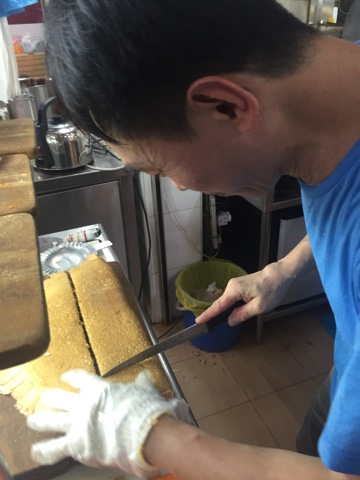
| Making the First Slice |
The timing was just perfect. Mr Lee, the owner of the Mee Chian Kueh stall at Blk 644 Hougang Avenue 8 had just put the final touches to his first batch of Mee Chian Kueh. Freshly made!
Having a go at the Mee Chian Kueh, I'd just wished that there were more grounded peanuts within. But I guess customers always want more of the best stuff.
Other Old School Peanut Pancake Stalls
Tiong Bahru Mian Jian Kueh
30 Seng Poh Road, Tiong Bahru Market
#02-34, Singapore168898
Tanglin Halt Original Peanut Pancake
48, Tanglin Halt Road, Tanglin Halt Market
Stall 16 Singapore 142048
References
1.Lee, M. K. August 23, 2015. Cheap & Good, How does Chiam See Tong's favourite peanut pancake taste? The Straits Times.
![]() |
| Focused on Cutting it Right |
Having a go at the Mee Chian Kueh, I'd just wished that there were more grounded peanuts within. But I guess customers always want more of the best stuff.
Other Old School Peanut Pancake Stalls
Tiong Bahru Mian Jian Kueh
30 Seng Poh Road, Tiong Bahru Market
#02-34, Singapore168898
Tanglin Halt Original Peanut Pancake
48, Tanglin Halt Road, Tanglin Halt Market
Stall 16 Singapore 142048
References
1.Lee, M. K. August 23, 2015. Cheap & Good, How does Chiam See Tong's favourite peanut pancake taste? The Straits Times.
Wednesday, March 18, 2015
[Special Edition] People, Places, Penang - The Tricycle Bread Seller
I may be asked about the rationale for writing a piece about a foreign island i.e. Why Penang Island rather than Singapore since my blog is called Singapore Trails. Is this a deviation from my original purpose of writing about Singapore?
Well, yes and no. You see, purists would say that Penang Island is no Singapore. But there are many similarities between these two islands, MANY! Penang is also a place where I can extrapolate what life was like in Singapore - the way we lived, the food we ate and the streets that we walked.
Penang Island is just about an hour plane ride from Singapore and we are privileged to be situated close to Georgetown, Penang, a UNESCO World Heritage Site. Being listed as a heritage site means that its architecture and cultural landscape will be largely protected against the rapid modernisation of towns and cities. In fast-paced Singapore, we can only catch hold of whatever remaining bits of heritage that we can hold on to.
Let me begin my story of Penang with the Tricycle Bread Seller.
The Tricycle Bread Seller
It was a pretty humid day and a yellow tricycle crawled into the back lane of Stewart Street. I'm sure that Mr Sekar, the owner of this "mobile office", had entered the lane to look for a reprieve from the blistering heat.
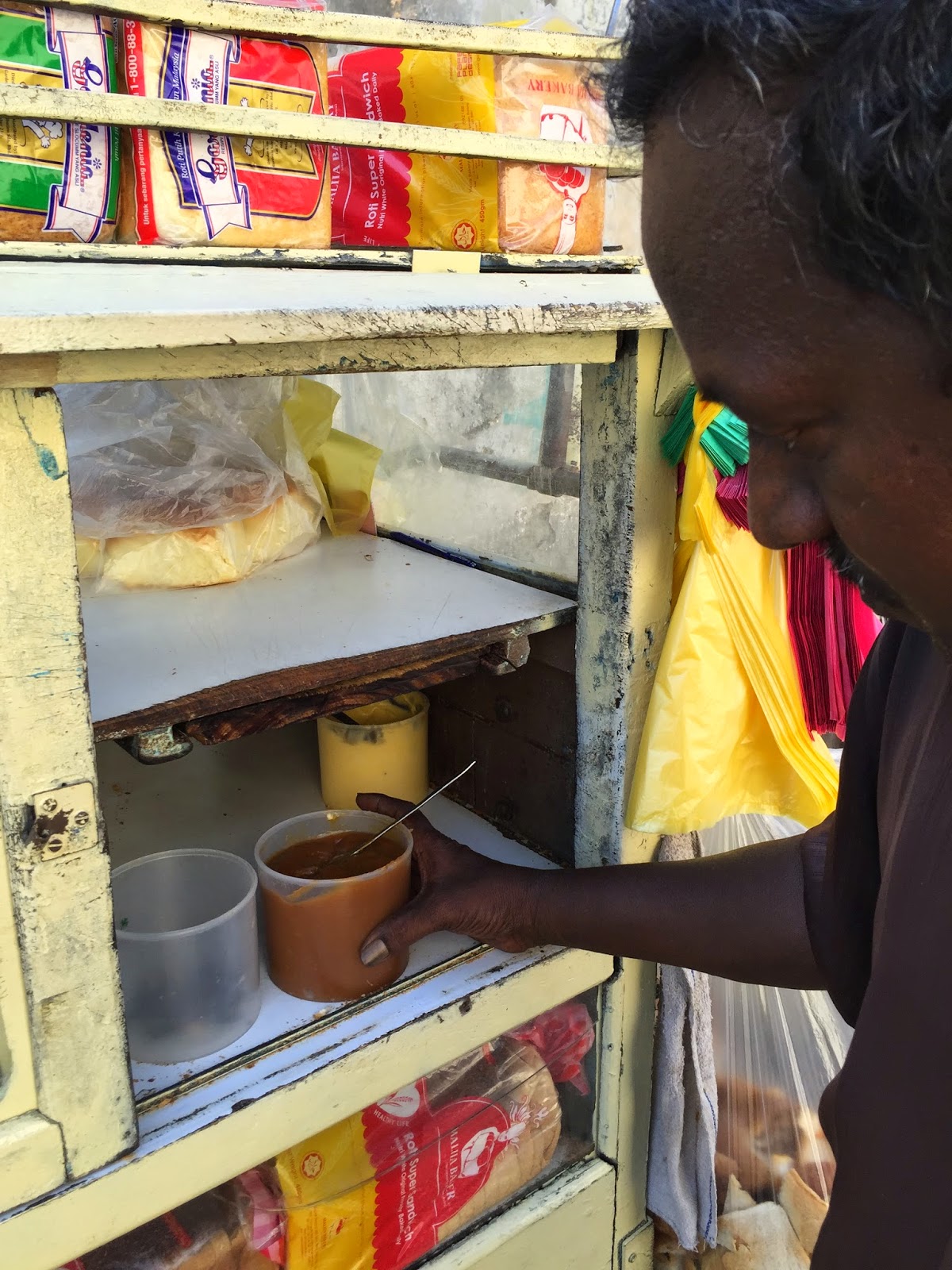
Me Sekar was keen to share his work. The bread on display were hygienically wrapped and were supplied by branded bread making companies. But what I was interested in was Mr Sekar's "ride". The lower cupboard stored his loaves of bread that he uses to create his mouth-watering kaya toast.
In the upper cupboard, Mr Sekar has his kaya and butter ready. The doors to the cupboard help to keep away the flies and dirt as he moves from street to street. As we said our farewells, Mr Sekar peddled off to hawk his "wares". There was a great sense of pride in what he does. Mr Sekar did not choose the easy way out by mounting his cupboards on motorcycles. Instead, he continues to serve the community by peddling his tricycle.
Tricycle Bread Seller in Singapore
I asked Mr Sekar to pose with his tricycle. He did. I'm not sure if he knows that in Singapore, this trade is no longer in existence. So when was the last time we saw such a tricycle bread seller selling bread on the streets?
Well, it seems that the last captured image of such a bread seller in Singapore was in 1982. (1) Though the mobile cupboards looked slightly different when I compared both the 1982 picture and the one that I'd taken recently, the concept of mounting these cupboards on a tricycle remains the same and Mr Sekar would not have looked out of place if we had placed him in the 1980s.
References
1. Pinsler, R. June 1, 1982. National Archives of Singapore. Retrieved on: March 19, 2015. http://www.nas.gov.sg/archivesonline/photographs/record-details/86e5aad5-1162-11e3-83d5-0050568939ad
Well, yes and no. You see, purists would say that Penang Island is no Singapore. But there are many similarities between these two islands, MANY! Penang is also a place where I can extrapolate what life was like in Singapore - the way we lived, the food we ate and the streets that we walked.
Penang Island is just about an hour plane ride from Singapore and we are privileged to be situated close to Georgetown, Penang, a UNESCO World Heritage Site. Being listed as a heritage site means that its architecture and cultural landscape will be largely protected against the rapid modernisation of towns and cities. In fast-paced Singapore, we can only catch hold of whatever remaining bits of heritage that we can hold on to.
Let me begin my story of Penang with the Tricycle Bread Seller.
The Tricycle Bread Seller
| In The back alley of Stewart Street |
It was a pretty humid day and a yellow tricycle crawled into the back lane of Stewart Street. I'm sure that Mr Sekar, the owner of this "mobile office", had entered the lane to look for a reprieve from the blistering heat.
Me Sekar was keen to share his work. The bread on display were hygienically wrapped and were supplied by branded bread making companies. But what I was interested in was Mr Sekar's "ride". The lower cupboard stored his loaves of bread that he uses to create his mouth-watering kaya toast.
| Mr Sekar shared about how he prepares the kaya toast |
Tricycle Bread Seller in Singapore
I asked Mr Sekar to pose with his tricycle. He did. I'm not sure if he knows that in Singapore, this trade is no longer in existence. So when was the last time we saw such a tricycle bread seller selling bread on the streets?
Well, it seems that the last captured image of such a bread seller in Singapore was in 1982. (1) Though the mobile cupboards looked slightly different when I compared both the 1982 picture and the one that I'd taken recently, the concept of mounting these cupboards on a tricycle remains the same and Mr Sekar would not have looked out of place if we had placed him in the 1980s.
References
1. Pinsler, R. June 1, 1982. National Archives of Singapore. Retrieved on: March 19, 2015. http://www.nas.gov.sg/archivesonline/photographs/record-details/86e5aad5-1162-11e3-83d5-0050568939ad
Labels:
Beyond Singapore,
Food,
Local Product,
People,
Transportation,
Vanishing Trade
Saturday, October 11, 2014
[People] Samsui Women in Singapore
We have followed the entire 24-episode historical drama - Samsui women - when it was shown in 1986. We have seen for ourselves how the Samsui women trod on with their lives even when the going was hard. Still, I did not know much about their lives.
So when I saw this book - Remembering the Samsui women - on the bookshelf, I knew that I had to read it. I've also extracted nuggets of rich information from newspaper articles.
![]() |
| A Samsui woman sculpture outside the Chinatown Museum |
Called "the toughest women in Singapore", Samsui women or colloquially known as Samsui Por, started flocking into Singapore near the turn of the century. This was followed by an influx of Samsui Por in the 1930s. Sau Eng was one of the Samsui Por (Women), shared about her reason for coming to Singapore from China in 1938. She was 26 years old then. (1)
"Day and night for 3 years, no rain...dry weather for 3 years, even if it rains, it's just such a drizzle that it can't even make the soil wet. Isn't that very difficult? So those grains will dry up." (2)
Another Samsui Por that the author had interviewed was Choi Yuk. She travelled with her mother-in-law to Singapore when she was 18 years old.
"Very terrible conditions...4 persons had only 1 meal a day...no money until paddy field had to be sold off, then came to Singapore." (3)
There were others who left their homeland due to the mistreatment dished out by their husbands or mother-in-laws. (3)
It was also a time where the world was just recovering from the Great Depression. The colonial rulers had limited the number of men coming into Singapore to work. There was no such restriction for women and children. During 1934 and 1938, Chinese women - driven by economic pressures and hoping to find their life partners husband, embarked on an arduous trip to Singapore. (3)
It has never been easy leaving the familiarity of a place for an unknown destination and future. So for the Samsui women to make this five-day sea journey in search of work, life in China must have been pretty bad back then. Each of them similar in that they were looking for a better life, but different in the sense that each of them has a different story to tell.
Arriving in Singapore
![]() |
| Photo: National Archive of Singapore (6) |
It was not a breezy boat ride into Nanyang (Singapore as it was known by the the Chinese). They would have to take a boat ride from their hometown to Guangzhou. Then to Hong Kong before moving again to Macau and finally to Singapore. The entire journey took them through seven days of choppy seas. A number of them, who were taking a boat for the first time, had to manage motion sickness, beyond other things such as cramped spaces within the boat, and unsanitary conditions.
When they arrive in Singapore, they were either picked up by their relatives. If not, these Samsui Pors settled themselves down in and around Upper Chin Chew Street or locally called Toufu Kai (Toufu Street). Even in the 1970s, Samsui women were still turning up at Cross Street "to sit at the five-foot way". (4)
The Samsui women interviewed said that houses along Toufu Street were decrepit; even worse than Hong Kong and Guangzhou. (7)
Post-War presence
![]() |
| Photo: National Archives of Singapore (5) |
In 1978, there were some 60,000 Samsui Pors left in Singapore as they continued to age, while other younger samsui women chose "alternative employment in factories or even civil service. (3) The Samsui Pors were also listed as a "must see" in some travel brochures. (1)
Contributions to Singapore
The hard work of these samsui women did not come to a nought. The hardy women played a part in the construction of "Capitol Building, Changi Airport, and the Development Bank of Singapore building." (8)
Family's Personal Experience
I was having a regular chat with my mother about the topic of the Samsui women and was surprised to hear from her that she had interacted with two Samsui women. This work-related converstion happened in the late 1960s when when my parents had just purchased their new flat. They paid for the Samsui women to work on tiling both the wall and floor.
My mom shared that Samsui women were renowned for quality and efficient work. They commanded more pay than other construction workers. Though my parents have long sold that flat, my mother still proudly states how neighbours would stop by our flat to gawk at the tile finishing.
Trustworthy; Hardworking; Resilient in the face of hardship. The Samsui women truly embodied that and more!
The Lost Red Headscarf:-
CCTV documentary
Part 1
https://www.youtube.com/watch?v=tyQxiHzez6M
https://www.youtube.com/watch?v=KSt04WBhtyw
Part 2
http://www.youtube.com/watch?v=Bdnff_a6RJ0
https://www.youtube.com/watch?v=tyQxiHzez6M
Words that played a part in the lives of the Samsui Pors :
Dai Hup Kar - The ships that brought the Samsui women to Singapore
Tsui Haak - Middleman whom they have to pay to get them to Singapore
References
1. Wee, M. (January 11, 1960). Work all day, then home to cook. Straits Times. P 6
2. Low, K. E. Y. (2014) Remembering the Samsui women. UBC Press. P111
3. Low, K. E. Y. (2014) Remembering the Samsui women. UBC Press. P112
4. Chew, M.L. (May 25, 1978). The Samsui Por. The Straits Times. P14
5. National Archives of Singapore. http://www.nas.gov.sg/archivesonline/photographs/record-details/b388ba32-1161-11e3-83d5-0050568939ad Retrieved on October 10, 2014.
6. National Archives of Singapore. http://www.nas.gov.sg/archivesonline/photographs/record-details/b38ee0fb-1161-11e3-83d5-0050568939ad Retrieved on October 11, 2014.
7. Low, K. E. Y. (2014) Remembering the Samsui women. UBC Press. PP125-126
Family's Personal Experience
I was having a regular chat with my mother about the topic of the Samsui women and was surprised to hear from her that she had interacted with two Samsui women. This work-related converstion happened in the late 1960s when when my parents had just purchased their new flat. They paid for the Samsui women to work on tiling both the wall and floor.
My mom shared that Samsui women were renowned for quality and efficient work. They commanded more pay than other construction workers. Though my parents have long sold that flat, my mother still proudly states how neighbours would stop by our flat to gawk at the tile finishing.
Trustworthy; Hardworking; Resilient in the face of hardship. The Samsui women truly embodied that and more!
The Lost Red Headscarf:-
CCTV documentary
Part 1
https://www.youtube.com/watch?v=tyQxiHzez6M
https://www.youtube.com/watch?v=KSt04WBhtyw
Part 2
http://www.youtube.com/watch?v=Bdnff_a6RJ0
https://www.youtube.com/watch?v=tyQxiHzez6M
Words that played a part in the lives of the Samsui Pors :
Dai Hup Kar - The ships that brought the Samsui women to Singapore
Tsui Haak - Middleman whom they have to pay to get them to Singapore
References
1. Wee, M. (January 11, 1960). Work all day, then home to cook. Straits Times. P 6
2. Low, K. E. Y. (2014) Remembering the Samsui women. UBC Press. P111
3. Low, K. E. Y. (2014) Remembering the Samsui women. UBC Press. P112
4. Chew, M.L. (May 25, 1978). The Samsui Por. The Straits Times. P14
5. National Archives of Singapore. http://www.nas.gov.sg/archivesonline/photographs/record-details/b388ba32-1161-11e3-83d5-0050568939ad Retrieved on October 10, 2014.
6. National Archives of Singapore. http://www.nas.gov.sg/archivesonline/photographs/record-details/b38ee0fb-1161-11e3-83d5-0050568939ad Retrieved on October 11, 2014.
7. Low, K. E. Y. (2014) Remembering the Samsui women. UBC Press. PP125-126
8. 7. Low, K. E. Y. (2014) Remembering the Samsui women. UBC Press. P173.
Labels:
Historical Site,
Singapore,
Singapore Book,
Vanishing Trade
Sunday, September 7, 2014
Sungei Road Thieves Market: I Came. I Saw. I Wandered.
It took a very nice gentleman to direct me to the historical flea market. He warned me that there were just a few stalls left. I withheld my judgement of the place and with my trusty foldie, I rode excitedly towards Sungei Road, looking forward to see what I would find.
But before we look into the present, let's take a stroll into the past.
| Taken from: http://eresources.nlb.gov.sg/ (1) |
Sungei Road market also had its character. Whenever anyone visits the market, they would have needed to tolerate the "nauseating smell that comes from the canal". (3)
Then, the stalls lined along the ground level of these shop houses which added to the quaintness of the place. (4)
In its heydays, the Sungei Road market saw more than 180 stalls selling different nick-knacks but some of these stallholders had resettled themselves in proper shops along Kelantan Lane, Syed Alwi Road and Sim Lim Tower. (5)
It was never smooth sailing for the stall holders there. The threat of seeing the closure of the market was mentioned as early as 1978. (6) In 1982, the Environment Ministry was also on-hand to tear down the temporary stalls. (7) Still, the stallholders returned to their old haunt in 1983.
The illegal stallholders had to play hide-and-seek with the Ministry of Environment officers. "It was only in late 1989" that these hawkers were given temporary permits to hawk their wares. (8) Business started to flourished again. There were even mobile food stalls that sold tasty Laksa and the likes.
But by 2000, there was no need for stallholders to request for permit, though the only condition was that they were only allowed to sell second-hand goods. (9)
The streets that they hawked their wares include Pitt Street and Larut Road.
To protect themselves from the weather, the stallholders erect temporary shelters using tarpaulin and big umbrellas.
As I walked along the streets, I was looking out for something that is worth my purchase. Army helmets, old kettles, religious amulets, all these items were not of my fancy.
Some of these items were so worn-out that the stallholder had just lumped everything together. It looked to me like a pile of junk. But I'm pretty sure that the gentleman selling these items must have felt that they were indeed worth a dollar or two.
Time was never an issue for these stallholders, especially if you were their regular customers. They took their time to chat with their customers, some of whom even sat on the side of the seller while chatting away about times gone by. But for those whom they are unfamiliar with, the stallholders were not as patient. "Le Chuay simi? " (What are you looking for?) was a retort by the stallholders, targeted at new customers who were disentangling some of his wares.
Alas, the end is near for these stallholders and there seems to be no reprieve. These stallholders will be asked to move, most likely permanently as the land will be use to build an upcoming MRT station. (10)
As I wandered through the flea market and had found nothing of my
liking, I know that many others would have found something interesting
that they will take along with them. If nothing else, at least the
memories of this place will be in our hearts forever.
1. Untitled. October 13, 1935. The Straits Times. http://eresources.nlb.gov.sg. Retrieved on: September 6, 2014.
2. Jalan Besar: Heritage Trail. http://www.academia.edu/3665785/Jalan_Besar_A_Heritage_Trail. Retrieved on: September 6, 2014.
3. Robinson Petang. October 2, 1953. The Straits Times. http://eresources.nlb.gov.sg. Retrieved on: September 6, 2014.
4. Cheong, S. October 26, 1979....and an old one. The Straits Times. http://eresources.nlb.gov.sg. Retrieved on: September 7, 2014.
5. Thieves' Market: Big Move Out Soon. November 30, 1981. The Straits Times. http://eresources.nlb.gov.sg. Retrieved on: September 7, 2014.
6. Sungei Road Stall Still Going Strong. August 14, 1978. The Straits Times. http://eresources.nlb.gov.sg. Retrieved on: September 7, 2014.
7. Kumar, S. August 11, 1982. The Straits Times. http://eresources.nlb.gov.sg. Retrieved on: September 7, 2014. P.8.
8. Yeo, R. June 1, 1991. Flea for All. The Straits Times. Factiva. Retrieved on: September 7, 2014.
9. Ho, M. October 12, 2001. How much for that broken phone. The Straits Times. Factiva. Retrieved on: September 7, 2014.
10. Flea market and the city. August 10, 2014. The Straits Times. http://www.straitstimes.com/news/opinion/more-opinion-stories/story/flea-mart-and-the-city-20140810 Retrieved on: September 7, 2014.
Labels:
Food,
Historical Site,
Local Product,
People,
Singapore,
Vanishing Trade
Subscribe to:
Posts (Atom)