Showing posts with label Beyond Singapore. Show all posts

Sunday, October 2, 2016

[Food] Heritage Dish of Johor: Laksa Johor

Laksa Johor [Photo Source: The Star Online]


When I first saw the headlines, I thought it must have been one of those arguments between countries over who has the heritage rights over a certain food. Though what Johor is saying here is that they want to gazette two of their local dishes - Laksa Johor and Asam Pedas. (Musa, 2016)

State Youth, Sports, Culture and Heritage committee chairman Datuk Zulkurnain Kamisan vaguely explained the difference of Johor's Asam Pedas to that of the other Malaysian states, saying that there's a difference in terms of its "hot and spicy gravy".

Laksa Johor
 
It's much clearer a difference for the Laksa Johor dish. It is said that the late Sultan of Johor, Abu Bakar, visited Italy in the 1800s. After that particular trip, he came up with the idea of replacing normal noodles with Italian spaghetti.

According to Makansutra, this dish is not commonly found even in Johor as it is tedious to prepare. The website then went on to provide the addresses of places that are offering Laksa Johor.

Even in the Johor Istana, the dish is only served at "special occasions and Hari Raya celebrations" (Loh, 2016). I'm pretty sure that our Singapore Ministers would have the opportunity to try the very best of Laksa Johor when they visit the Sultan during Hari Raya.
only at special ceremonies and Hari Raya celebrations.

Read More : http://www.nst.com.my/news/2016/07/158409/rich-and-royal-taste
only at special ceremonies and Hari Raya celebrations.

Read More : http://www.nst.com.my/news/2016/07/158409/rich-and-royal-taste

So other than being a favourite dish of royalty, what else makes Laksa Johor a heritage dish? I like how this article puts it - it's a heritage dish when it helps to Bind Generations. (Ismail, 2016)


References

Ismail, S. September 22 2016. Dishes that bind generations. New Straits Times Online. Accessed on October 2, 2016. http://www.nst.com.my/news/2016/09/175063/dishes-bind-generations

Loh, P. July 15 2016. Rich and royal taste. New Straits Times Online. Accessed on October 2, 2016.
http://www.nst.com.my/news/2016/07/158409/rich-and-royal-taste

Makansutra. November 26 2013. The Royal Laksa Johor. Accessed on October 2, 2016. http://www.makansutra.com/stories/5/1029/TheRoyalLaksaJohor

Musa Z. September 30 2016. The Star Online. Johor to gazette ‘laksa’ and ‘asam pedas’ as heritage dishes. Accessed on October 1, 2016. http://www.thestar.com.my/news/nation/2016/09/30/johor-to-gazette-laksa-and-asam-pedas-as-heritage-dishes/

Sunday, February 21, 2016

[Singapore Islands] Pulau Blakang Mati: Mt. Imbiah Battery

Mr Peter Stubbs Sharing About the Gun Placement

Give me a storyteller and I'd be totally engaged. So when Mr Peter Stubbs came forward to lead the tour, I can sense his strong passion of military matters at Sentosa formerly known as Pulau Blakang Mati. He had dedicated large amount of time to explore the area and is also the author of the Fort Siloso website. http://www.fortsiloso.com/guns/bl/bl.htm

Mounting of Mt. Imbiah's 9.2-inch guns

Peter walked with us to the top of Mt. Imbiah (Or previously spelt as Mt Imbeah). From there, he brought to life what life was like for the British gunners. Peter also dispelled the mistruth that the guns were pointed the wrong way and how the 6-inch guns were used against the Japanese forces, though Mount Imbiah saw no bombings by the Japanese while the sister sites at Fort Siloso and Mount Serapong were battered by Japanese fighter bombers.

The holding area where the ammunition were stored

We saw the gun placement as well as the magazine tunnels under the gun placement where the explosive shells were kept. The cylindrical-shaped marks have now been etched into the ground.

Walking Through the Dark and Narrow Tunnel

3 Interesting Facts about Mt. Imbiah

1. Mt. Imbiah was spelt as Mt. Imbeah till the late 1970s. 1
2. The gun at Mt. Imbiah was regularly fired as part of the British Forces practice run since the 1920s. 2
3.  Mt. Imbiah was known as Point 202, Blakang Mati Island 3


References 

1. Siloso's Big Bang. August 12, 1979. The Straits Times. P14.
2. Untitled. February 15, 1913. The Singapore Free Press and Mercantile Advertiser. P6.
3. Untitled. June 4, 1924. The Singapore Free Press and Mercantile Advertiser. P12.

Sunday, January 31, 2016

[Singapore Islands] Pedra Branca

Pedra Branca: The Book (Amazon)

In the past, Pedra Branca was every sailor's nightmare. But in 1979, Malaysia and Singapore clambered over this rocky outcrop, together with two other outcrop called Middle Rocks and South Ledge. The deliberations and discussions as to who owns Pedra Branca and the other outcrop spanned more than a decade. The two governments then agreed to allow the International Court of Justice (ICJ) to determine who has the sovereignty over these outcrop. (Jeyakumar and Koh, 2009)

The book - Pedra Branca - published in 2009 had also prove to be a very good read.

As of February 3, 2017, Malaysia has lodged an appeal to the ICJ to revise the previous ruling made. The Malaysian government has said that they have discovered three new documents from the United Kingdom National Archive. (Naidu, Feb 2017)

The three documents are:-

1. An internal correspondence of the Singapore colonial authorities in 1958
2. an incident report filed in 1958 by a British naval officer and
3. an annotated map of naval operations from the 1960s

[Update: 12 Aug 2017]: Malaysia has even built a base on the Middle Rocks to stake their sovereignty over the rock outcrop.


So why is this situation so important to both countries? Well, the first reason is about sovereignty. In a very basic playground talk, "If it's mine, it's mine". Also, though Pedra Branca may be just a small outcrop, occupying it will mean having control of the maritime movement in and out of the Straits of Singapore.


3 INTERESTING FACTS ABOUT PEDRA BRANCA

1.  Most Easterly Island of Singapore

Pedra Branca (Pulau Batu Puteh as it is known in Malaysia or the former Coney Island) is the eastern most point of Singapore. It's situated at approximately 24 nautical miles to the east of Singapore. The island is actually closer to Indonesia's Bintan Island than to Singapore. (ibid)

Source: Ministry of Foreign Affairs

2. It's all about rocks and stones

The British erected a lighthouse on Pedra Branca in 1850 and named it after the late Captain James Horsburgh, a navigator and hydrographer. (Koh and Chew) Pedra Branca itself is an uninhabited "reef of white stone-rocks of granite". (Cornelius-Takahama)  The granite stones used to build the lighthouse came from the granite quarry of Pulau Ubin. (Koh and Chew)

Aerial View of Pedra Branca. Source: China Post


3. Invited and Uninvited Dignitaries

When the foundation stone was laid on May 24, 1850 to commemorate the Queen's birthday. British dignitaries including government officials, naval personnel, foreign consuls and merchants graced the launch. (The Straits Times)

Fast forward to 1998. Relation between Malaysia and Singapore were going through a rough patch as both countries were fighting over who had the sovereign rights over Pedra Branca. Former Malaysian Prime Minister Dr Mahathir tried to get close to the outcrop but was then warned by the Singapore Navy to stay away, in which he did to prevent any potential skirmishes. (Hussein, 2009)


A litograph by J. T. Turnbull and T. Picken produced in 1850. (Horsburgh Lighthouse)

References

Amazon.com. Accessed on January 30, 2016. Retrieved from http://ecx.images-amazon.com/images/I/51MmRK6EOTL._SX334_BO1,204,203,200_.jpg

Cornelius-Takahama, V. Pedra Branca. Singapore Infopedia. Accessed on January 31, 2016. http://eresources.nlb.gov.sg/infopedia/articles/SIP_722_2005-01-20.html

Foo, Y. C. May 24, 2008. World Court rules Singapore owns strategic isle. China Post.
 http://www.chinapost.com.tw/photos/default.asp?ID=157824&GRP=C

Horsburgh Lighthouse. University of Otago. Accessed on January 31, 2016. http://s3.amazonaws.com/ourheritagemedia%2Foriginal%2F2fbf089ced8216bf4b953abebf366cd7.jpg

Hussein, Z. December 20, 2008. Pedra Branca: Behind the scenes. The Straits Times. P26.

Jayakumar, S. & Koh, T. (2009). Pedra Branca. The road to the world court. NUS Press: Singapore. P 161.

ibid. P162

Koh, Q. R. V and Chew, V. Horsburgh Lighthouse. Singapore Infopedia. Accessed on January 31, 2016. http://eresources.nlb.gov.sg/infopedia/articles/SIP_107_2005-01-20.html

Ministry of Foreign Affairs. Accessed on January 30, 2016. http://www.mfa.gov.sg/content/dam/mfa/images/media_center/special_events/pedra_branca/RevisedmapshowinglocationofPedraBranca%28SingaporeMemorial%29.jpg

Naidu, S. (February 4, 2017). 3 UK documents cited for Malaysia's application to revise Pedra Branca decision. Channel News Asia. Accssed on February 4, 2017.  http://www.channelnewsasia.com/news/singapore/3-uk-documents-cited-for-malaysia-s-application-to-revise-pedra/3492172.html

The Horsburgh Lighthouse. May 28, 1850. The Straits Times. http://eresources.nlb.gov.sg/newspapers/Digitised/Article/straitstimes18500528-1.2.10.aspx

Sunday, October 11, 2015

[Hong Kong Heritage] Ping Shan Trail

Calm Before the Storm
Landing in Hong Kong!
I'm here in Kong Kong and it's great to be able to continue my walking trail in this bustling metropolis. 
This is my sixth trip to this Special Administered Region (SAR) but by far the most interesting one as I had the opportunity to achieve many 'firsts' on this trip and the first amongst which started with my flight into Hong Kong. As our Airbus A380 started it's descent, the aircraft started to rock. The pilot voice crackled over the public announcement informing us that there would be a series of turbulence. The aircraft took a beating and only landed after one failed attempt.

Only when I exited the departure hall that I found out that the aircraft was battered by gale wind from Typhoon Mujigae. I've truly never felt such turbulence and for such a long period of time. Anyway, what's more important is that the skillful Singapore Airlines pilots did well in landing the aircraft.


Visiting New Territories

Rental flats in Fu Tai Estate

Previously, the lure of the fast-paced life in Hong Kong saw me staying and travelling in and around Kowloon or Hong Kong Island. But for this 12-day trip, I'd spent most of my time in New Territories close to Fu Tai Estate.


Ping Shan Heritage Trail

Tsui Shing Lau Pagoda

 I was most excited to do this trail as this was Hong Kong's very first Heritage Trail that the Antiquities and Monuments Office and the Architectural Services Department had put together in 1993. First stop - Tsui Shing Lau Pagoda. This more than 500 year-old pagoda is the oldest in Hong Kong. (1) It's said that scholars once walked around the Pagoda seven times clockwise so that they could ace their examinations. 


Sheung Cheung Wai Walled Village

Next up, a 200-year old walled village. The walls coupled with a moat that has since been covered, provided residents a good protection from their enemies. (2) The guide was able to show us what was previously holes in the wall. Those were used by the defenders to point their weapons at the enemy. There were other historical buildings such as the old well, Yeung Hau Temple, Tang Ancestral Hall and many more for visitors to explore.

View from The Hilltop Visitor Centre

We ended our tour at the Heritage Trail Visitor Centre. The building, perched up on the hill, was once a British police station that was constructed in 1899. The building houses a number of historical and cultural artifacts that showcased what Ping Shan was like in the past.


Doors that lead visitors into the visitor centre

What was most inviting about the visitor centre after more than an hour walk in rainy and humid weather was the air-conditioning in the building. Well, such weather in Hong Kong is a first for me too as all my other visits were in December and where the temperature stayed a cool 17-23 degrees celsius. Still, this trip was extremely beneficial for me as I saw a side of Hong Kong that I'd previously not seen.


References

1. Discover Hong Kong. Accessed on October 25, 2015. http://www.discoverhongkong.com/seasia/see-do/culture-heritage/historical-sites/chinese/ping-shan-heritage-trail.jsp

2. Antiquities and Monuments Office and the Architectural Services Department. Accessed on October 25, 2015.  http://www.amo.gov.hk/en/trails_pingshan1.php?tid=2

Sunday, July 12, 2015

[Singapore Islands] Pulau Semakau: An Island in the Sun?

Marine Transfer Station
The Singapore government recently launched the Phase II development of Pulau Semakau on July 11, 2015. This increases Singapore's capacity to "meet waste disposal needs" for the next 20 years. (1) Refuse was previously dumped at Lorong Halus just off Old Tampines Road till 1999. (2)

Visiting Pulau Semakau


I visited Pulau Semakau in 2013 as part of an organised trip. By then, the island was already a landfill. The guide shared much about the biodiversity in and around the island, but nothing about the island's history. It was a talk by Anthropologists Dr Vivienne Wee, Dr Geoffrey Benjamin, and Ms Normala Manap that opened my eyes to the value of these southern islands.

Pre-Raffles? 

The island was believed to be rich in history. In 1991, a group of explorers found pottery that were probably more than 200 years old. Dr John Maksic opined that part of a clay jar found could have even been from the 12th century.  (3) 

Resettlement

In 1977, more than 600 villagers were ordered to move to mainland Singapore. From thereon, the island laid uninhabited, though not totally. When Dr John Maksic visited Pulau Semakau in 1991, a Malay couple - Mr Rani bin Omar and Mdm Minah bte Gap was seen living on the deserted island. (4)

They shared that:-

a. The villagers of Pulau Semakau and Pulau Seking were closely related. They attended each others' weddings
b. They collect fresh water from the larger island of Pulau Bukom

In a more recent article, Mdm Minah shared about how both she and her husband fought off Indonesian interlopers when they were staying on the island alone. Mdm Minah's son shared his pain of losing the island. He thought that the new government led by the late Mr Lee Kuan Yew would continue to allow them to live peacefully on the island. The late Mr Lee had also visited the Pulau Semakau and had promised the islanders modern facilities such as "police post, community clinic and Malay school". Instead by the 1970s, the islanders lost their entire island when they were asked to move. (5)

Interestingly, Former Senior Minister of State Mr Sidek Saniff had previously taught in the Island's school in 1958. (6) There was only one school - the Pulau Semakau Malay School and it was said that the school had been in existence since before World War 2. (26) 

Here're some highlights of Pulau Semakau over the years.

1923
Police were alerted to a fight between Malays and the Chinese. The Chinese coolies were working in the lime kiln there (7) 

1948
The British government issued identity cards to the islanders (8)

1950
The islanders, consisting of Malay fishermen and Chinese traders, built themselves a school for 30 Malay students. But no teachers were available to teach these students (9)

1951
The Pulau Semakau school was finally opened. The Pulau Semakau Malay school started with five Chinese and 25 Malay students, all learning the Malay language. The Chinese residents of Pasir Panjang contributed $700 to buy timber, attap and cement to build the school while the Malays helped in the building. (11) (12) (16)

With the school up and running, other islanders from Pulau Sudong, Pulau Sebarok and Pulau Senang had asked if the school could also take in their children (10)

1952
The population of the island was at about 350 islands. It was also listed that in 1940, The Singapore Rural Board thought that the island was uninhabited (13) As the island was inhabited, the Board had thus agreed to buy a water boat and build water storage tanks for the islanders. (14)

1954
A floating medical dispensary coupled with a nurse would provide medical service for the people every Wednesday (15)

1955
The Mobile Film Unit would show their films on the islands to provide the islanders with some entertainment (16)

1957
The government had decided to build Quarters for teachers, Postman and Postal Agency and Sundry shops.

1958
Costing $10,000, the islanders welcomed their first postal agency. (18) 

1959
The Ministry planned to build a water tank to arrest the acute water shortage issue during the dry season. (19)

1960
The Yang di-Pertuan Negara Inche Yusoff Ishak visited the island, and planted a coconut tree to commemorate this event. The Penghulu of the island, Inche Abdul Jalil bin Kerip pledged the island's loyalty to Singapore's government. (20) (21)

1963
A new Community Centre was built. (22)

1965
The Penghulu receives a Public Service Star medal. (23)

1969
The Singapore Armed Forces started to use the island for its live firing exercises. (24)

1972
Indonesians were still allowed to move freely amongst Singapore islands. (25)

1973
The population of Pulau Semakau was said to be 1,826 residents. (26)

1975
It was reported that the island was to be developed to house a petrol chemical complex. Swamp, foreshore and seabed would be reclaimed. (27)

1976
More talks about developing the island. Now the reports state that it would be used for shipbuilding and other marine-oriented industries. (28)

Old graves were exhumed and moved to Mount Vernon Crematorium. (29)

1977
Villagers were required to move away from their island. (4)

1978
The island was deemed by the newspaper as a 'relatively undisturbed' island with coconut tree and fishing villages. (30)

1980
By now, the villagers of Pulau Semakau have been moved to the mainland and the island has become a dumping ground of waste materials dredged up from the sea. (31)

1982
A decision was made to join both Pulau Semakau and Pulau Seking. At this point, the newspaper report had still mentioned that it was done to house a international petroleum centre. (32)

1988
First mention of Pulau Semakau being a offshore refuse dump. (33) 

At this point, community centres are still bringing their residents to the southern islands (Including Pulau Semakau) for tours. (34)

1989
The newspapers mentioned that the island is now uninhabited "with only one watchman living there". It was also reported by a NUS professor that corals lying around the island have already been damaged since the early 1960s due to reclamation work done on the island. Soil dug up from the building of the Central Expressway, and earth spoils from Pulau Seraya Power Station were also dumped into the sea off Pulau Semakau. (35)

If things did not seemed bad enough with the island being used for waste disposal, the government shared about their plans to build a toxic waste plant on the island itself. (36)

Still on its environment, it was reported that marine life was thriving in and around the water of Pulau Semakau and that the artificial reef that was built using old tyres and cement was a success. (37)

1991
Adventurers claimed that they have found artefacts of more than 200 years old along the beach and also other parts of the island. (3)

1993
Then Environment Minister Mah Bow Tan said that the offshore landfill will see Singapore through to 2045. (38)

1994
Parliament agrees to the reclamation project of the island. (39)

2006
Former Environment and Water Resources Minister Yaacob Ibrahim announced that Pulau Semakau would be ready for anglers and nature lovers to visit. (40)

2015
Pulau Semakau has been further expanded to meet the demands of Singapore's waste disposal. (41)


References

1. Chan, L. E. July 11, 2015. Singapore's waste disposal needs get a boost. Channel News Asia.
http://www.channelnewsasia.com/news/singapore/singapore-s-waste/1976976.html (Accessed on July 11, 2015)
2. Raffles Museum of Biodiversity Research. The DNA of Singapore. http://lkcnhm.nus.edu.sg/dna/places/details/19 (Accessed on November 24, 2014)
3. The Straits Times. October 4, 1991. Adventurers find ancient artifacts on Semakau. P26.
4. The Straits Times. October 6, 1991. Deserted Island is Home to Rani and his Wife. P12.
5. Marsh, J. May 24, 2015. Forgotten Singapore: evicted islanders grieve for lost paradise. http://www.scmp.com/magazines/post-magazine/post-magazine-may-24 Accessed on July 11, 2015.
6. The Straits Times. March 31, 1993. Just when you thought it's safe to step into the water.
7. The Straits Times. March 26, 1923. Affray at Pulau Semakau. P8.
8. The Straits Times. November 14, 1948. Mobile teams help register. P1.
9. The Straits Times. July 24, 1950. They Built a School. P7.
10. The Straits Times. March 6, 1951. They have to go by boat to School. P10.
11. The Straits Times. January 9, 1951. 5 Chinese boys to learn Malay. P15.
12. The Straits Times. January 3, 1951. 5 Islanders get own school and unity. P7.
13. The Straits Times. August 22, 1952. Island that's not in the book. P9.
14. The Straits Times. June 20, 1952. Now they can have water.  P9.
15. The Straits Times. March 1, 1954. A Battle Begins in Singapore Today.  P8.
16. The Straits Times. March 7, 1955. Advertisement. P9.
17. The Straits Times. February 2, 1955. Advertisement. P5.
18. The Straits Times. September 7, 1957. Advertisement. P10.
19. The Straits Times. August, 1959. Better Condition for 3,000 Islanders. P11.
20. The Straits Times. February 1, 1960. Tree to mark visit. P1.
21. The Straits Times. February 1, 1960. Inche Ishak to islanders: We have plans to help you. P4.
22. The Straits Times. September 10, 1963. New Community Centre. P4.
23. The Straits Times. May 1, 1965. List of main Singapore awards. P9.
24. The Straits Times. February 29, 1969. Artillery firing. P8.
25. The Straits Times. August 21, 1972. Indonesian islanders join in joy of sea carnival. P27.
26. Sidhu, K. S. June 3, 1973. The island folks and men who guard them. The Straits Times. P10.
27. The Straits Times. July 30, 1975. Go-ahead for reclaimed land in Changi. P9.
28. The Straits Times. April 27, 1976. Semakau to be turned into big marine base. P5.
29. The Straits Times. April 26, 1976. Advertisement. P24.
30. Byramji, N. October 1, 1978. The unspoilt islands for walks in the wild. The Straits Times. P1.
31. Chee, L. September 9, 1980. Marco Polo removing 'high spots' in Singapore. P13.
32. Lim, J. September 21, 1982. $600m reclamation to join two islands. The Straits Times. P1.
33. The Business Times. March 23, 1988. Plan to use Semakau for offshore refuse dumping. P2.
34. The New Paper. August 1, 1988. Southern islands picnic. P38.
35. Liu, M. February 26, 1989. Govt will prevent dump site from polluting sea. The Straits Times. P14.
36. de Silva, G. October 7, 1989. Singapore looks at setting up of an offshore toxic waste plant. P44.
37. Goh, J. October 17, 1989. Man-made reef lures marine life. The Straits Times. P22.
38. Nathan, D. September 23, 1993. Another $1b landfill if rubbish keeps piling up, says Mah. The Straits Times. P3.
39. The Straits Times. July 27, 1994. 350 ha reclamation off Pulau Semakau gets nod. P.20.
40. Hooi, A. March 9, 2005. Fancy a nature trek at Pulau landfill? The Straits Times. P5.
41. Wee, C. F. July 12, 2015. Biggest rubbish dump grows bigger. The Straits Times. 

Wednesday, June 17, 2015

[Cameron Highlands] Brinchang: A Stop Point

After spending my first few hours in Cameron Highlands, I was confident enough to go beyond the boundaries of Kea Farm. In truth, there was only one road that leads to the different townships and as such, one cannot get lost. 

Visitors who want to head from Tanah Rata to Brinchang and vice versa will thus need to pass by the this township. To get to Brinchang from where I'd stayed, it took me just a simple 10 minutes drive through the soft meandering road and breathtaking mountains.

This town has its own fire station and mosque. There are also many small hostels if you're looking at budget stays. You can even find Colonel Sander's Kentucky Fried Chicken here! My family drove into this town on a wet evening and we had our very first steamboat in Cameron Highands. It was not the best though. (For our fav steamboat, check out my post on Kea Farm). 

1. Big Red Strawberry Farm

There are a number of strawberry farms in Cameron Highlands. But if you're staying around Brinchang, then this strawberry farm is one that you should visit. The drive in was already interesting enough. I'd to take a 15 degree slope all the way up to the farm. Though called a strawberry farm, the owners chose to also grow flowers and vegetables. They also had a good collection of cactus.

2. Food Galore

Brinchang is brimming with restaurants ranging from normal zhichar (Cooked dishes) to their tall chimney steamboat. If ever you want fast food, KFC is on hand to serve you that 13 herbs and spices chicken. But what got my family excited about was the roadside food stalls that sold fired stuff. From crackers and curry puffs to tapioca and sweet potatoes. We threw all cares into the wind as we usually do not eat road side food. The taste of the food was just extraordinary. I'm sure that the piping hot food also helped play a part in increasing the level of tastiness.

3. Time Tunnel Museum

After all the feasting, you come to this oddity of a place. How is it that there's a museum at 1,000m? Well, the museum provides visitors with the history about the Orang Asli around the mountainous area, and also interesting vintage memorabilia of Cameron Highlands over the years.


Sunday, June 14, 2015

[Ipoh] City of Millionaires

Population size: 700,000
Distance from Singapore: 556km

As so Ipoh is called - a quaint town that seemed deserted as I drove into Malaysia's fourth largest city. "Where are the people?" There were cars, but barely anyone was on the streets.

Seemingly, I found most of them in the shopping mall. Ipoh Station 18 is one of the more happening malls with good restaurants and a healthy sized crowd. Even though it was a Sunday, the crowd size was still manageable. 

There's a straight flight from Singapore to Ipoh but I chose to land at Kuala Lumpur (KL) because I wanted some element of a road trip. Moreover, the big rental companies such as Hertz and Avis were only located in KL.

It was a 2.5 hours drive to Ipoh and the N-S road was well-metalled.

The demographics see a larger group of Chinese whose ancestors had toiled in this state to extract tin as early as the 1820s.

I stayed there for a night in preparation of my drive up to Cameron Highlands. 

Three things that is interesting in Ipoh:-

1. An Interesting Stay

I checked out Trip Advisor for a unique hotel and the name - M Boutique Hotel came up. Situated about 10 minutes drive to the major eateries, the hotel was indeed unique. The hotel had taken on a 1930s theme starting from its reception counter - old jerry cans, wall-to-wall medical boxes, to interestingly decorated rooms. Even the access card was placed in cute cover with the wifi password being written on a movie stub. Just below, the hotel sees a classily designed Old Town White Coffee Restaurant where we had our hotel's complimentary breakfast. 

2. White Kopi Time

The pioneer of white coffee - Kopi Kedai Sin Yoon Loong started serving their first glass of coffe some time in 1937. Now, the coffee shop still sells its brand of coffee. Though they serve food, most of their clientele were there just for their coffee. A must not miss! 

3. Every kind of chicken
You've heard of paper wrapped chicken (纸包鸡), but when in Ipoh, you have to try either the salted chicken or their dried herbal chicken. A number of shops selling these famous-styled chicken can be found along Jalan Yau Tet Shin

We wanted something healthier so we gave the herbal chicken a go. We also topped it up with wanton mee and char siew mee. If you ordered wanton mee, you will only get that, wanton and mee. The herbal chicken was a tad bit dry but was indeed tasty. 

Sunday, June 7, 2015

[Special Post] Earthquake at Mount Kinabalu


Mount Kinabalu holds a special place in my heart. Though it was about 1,500km away, it was where I celebrated my 40th birthday with my loved one and family friends.

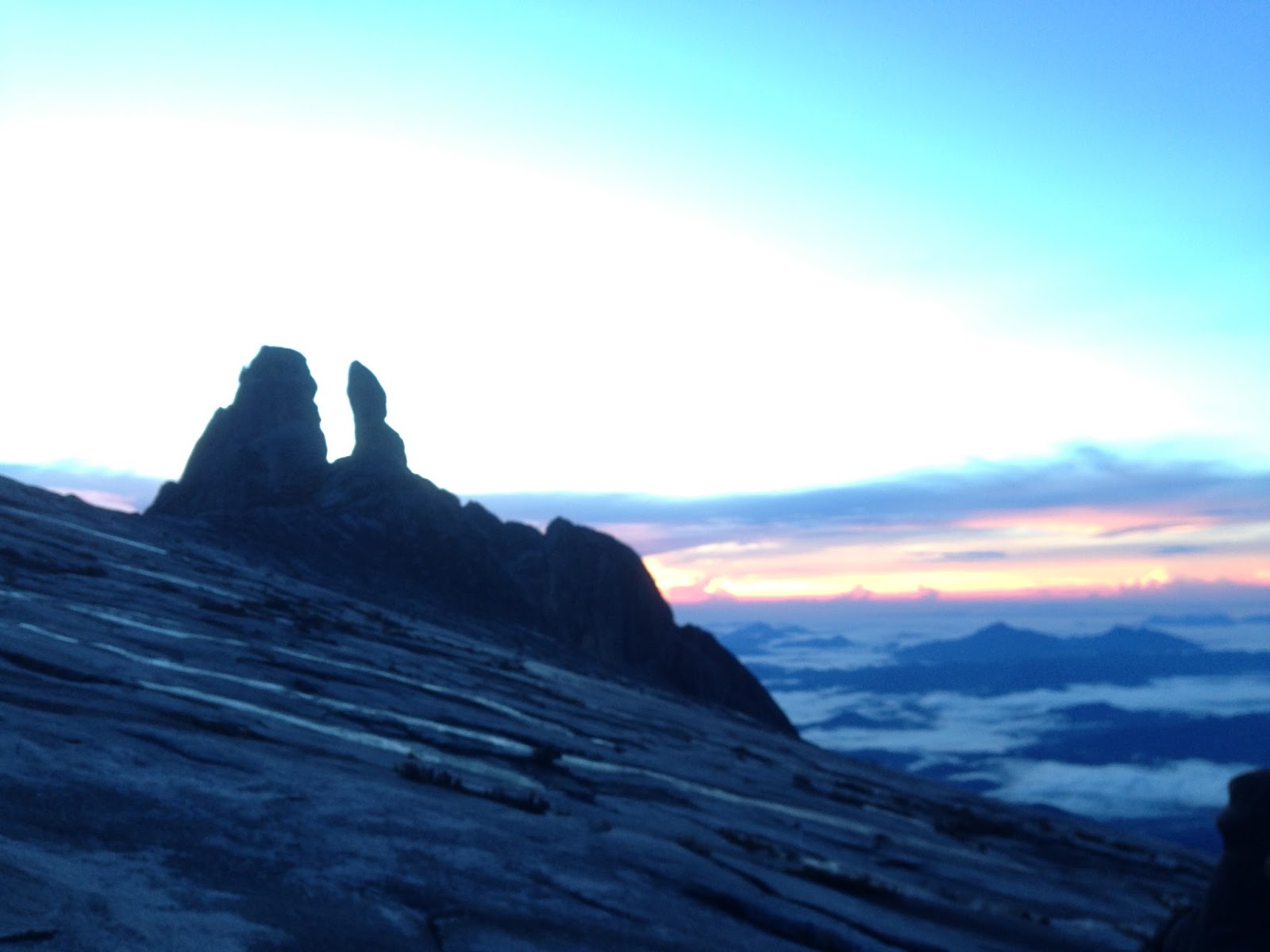
When news broke of the earthquake at Mount Kinabalu and that one of the key rock formations - The Donkey ears - has been destroyed, I felt the loss of all Sabahans.

Picture of the Donkey Ears rock formation
Then news started floating in about missing people and possibility of deaths. My guts wrenched and I felt pain. Pain because those who died were there to conquer a peak. Pain because lives were lost. It has hit even closer to home as of today, a 12-year old Singaporean had lost her life when the earthquake struck. Eight Singaporeans are still unaccounted for.

I whatsapp my guide to find out how is he doing and the reply I had received from him speaks volume. Just two words , "very sad". No further words were needed to express his pain.

The mountain lies in the no-earthquake zone. Really, nobody expected this. Neither did the parents of the young students whose children were there. 

I am a parent myself and I feel pained by this disaster, but I will never ever be able to feel the pain that they are feeling. I pray that they that peace beyond our understanding will transcend upon them.

My guide (with the red haversack), like all other guides, has always put us as his priority

For the guides, I've experienced first hand how they care for tourists. They are even willing to carry tourists on their backs up or down the mountain. They could have saved themselves but it is always in their nature to care for those around them. To these warriors, thank you so much. It's an honour to have walked beside you.

I've written in to Borneo Post to honour these guides. Hopefully, my email will reach the eyes of the Sabahan state government as well as the Malaysian government so that these guides are properly cared for.

I have been closely monitoring the situation at Mount Kinabalu and my thoughts go out to the people of Sabah and Malaysia. I am writing to ask that the government look into honouring the mountain guides for their bravery and for putting Malaysia on the world map.

I was a climber of Mount Kinabalu in 2013 and had the opportunity to experience the true care and concern showered upon us by our mountain guides. They moved quickly up and down the mountain slopes to ensure that we were safe. They carried large bags, and even people when the latter could no longer complete the climb. They were heroes to all who have climbed this mountain.

The local mountain guides had once again stood out as heroes in this recent unfortunate incident. These guides were there to cut out paths and laid lines to ensure that those caught in the earthquake could make their way down to safety. For those who were incapacitated, these guides carried them through the boulder-strewn path.

These mountain guides have indeed put their lives on the line. As such, the Malaysian government should consider honouring these heroes and also, help them through this difficult period where they will be effectively out of job for the next three weeks or more.

Friday, March 27, 2015

[Special Edition] People, Places, Penang - Bukit Bendera


Penang Hill or Bukit Bendera is one of the tallest point in Penang (731 m). There are two ways in getting up to the hill. One is by a narrow winding road, while the other is a direct route up the hill via a furnicular or inclined railway.


Arriving at the top of the hill, one will be greeted with a cool breeze that sweeps across the highland. Though when I was there, the cool breeze was rather fleeting. The high noon sun ensured that I received little of the cool breeze.


True to Penang's style and culture, food can be found anywhere, even on top of this hill. Just a couple of steps away from the hilltop railway station, you will enter the Cliff Cafe. This two-storey cafe offers hawker fare such as fried kuey teow, and local fav assam laksa.


Truly, the excitement of visiting Penang Hill was the ride in the furnicular train. At the summit, there was not really much one could do, though I'm pretty sure it would be far more visually pleasing if it had been a slow hike up the hill while taking in the fresh air.


Still, we had our family portrait drawn, played with the caged animals, and caught a panoramic view of Georgetown.

Sunday, March 22, 2015

[Special Edition] People, Places, Penang - Wonton Mee


Wonton noodles from three different stalls

Three days in Penang, three tries of wonton noodles. It was paradise. The dish or at least the wonton originated from Canton, China and how it's cooked and the ingredients differ from country to country. (1)

One thing for sure is that wonton noodle can be found in countries where there is a Chinese diaspora, such as Singapore, Malaysia, Hong Kong and China. 

In Penang, we tried out the wonton noodles from three different places. There is a similarity amongst all three noodles from Penang as all stallholders used dark sauce for seasoning.

have to say that I'm no food connoisseur but I still have my preference. So here're the three wonton noodles stalls that we had sunk our teeth in. 1. From Gurney Drive Food Centre (Top); 2. CF Hawker Centre along Armenian Street (Left), and 3. the nondescript wonton noodles stall along King Street(Right). 

Well, Surprise Surprise, the winner is the one from the nondescript stall! So here's what I think of each of the stall.

1. Gurney Drive Food Centre


Business at Gurney Drive was brisk though the queue to order a bowl of wonton noodle was negligible. The lady owner asked me what I had wanted in pretty fluent English. Actually, all the hawkers that I ordered my food from could speak pretty decent English as Gurney Drive Food Centre caters to both the locals and to no small extent, the foreigners. 

I can say that this stall puts together a well decorated bowl of wonton noodles. There even threw in a fried wonton, not for free of course but with an additional charge of RM1. I did not like it as I was not asked if I'd wanted the fried wonton. But small matter. Though the noodles here are the most expensive amongst the three stalls.

2. CF Food Court


CF Food Court sits at the junction of Armenian and Victoria Streets. There are numerous stalls selling everything from seafood to fried noodles. We chose a table that was closest to the wonton noodle stall. Other than the char siew and vegetables that comes with wonton noodles, the stall had also added chicken strips.

3. Nondescript wonton noodles stall

I'd just finished my walk around Fort Cornwallis and had asked the counter staff where I could get food. He pointed me towards Wisma Great Eastern building which I could see from the fort. The staff mentioned that I could either choose to eat at the mamak stalls or the various coffee shops around that vicinity.
 
I tentatively made my way towards the junction of King Street and Bishop Street, not sure of what I'd come across.


The wonton noodles stall was located at the entrance way of the coffeeshop and was run by a family - a husband and wife team, plus their daughter. The man who was preparing the noodles had that peaceful smile on his face. I could see that he is putting in his full love and care for each bowl of noodles that he prepared. Un-rushed by the hustle and bustle of the happenings around him.

Even though his was considered somewhat of a roadside stall, I was comforted by the fact that everything at his stall was pretty clean and well maintained. His zen-ish way took over me and when I was told by his daughter that I would need to wait for 15 minutes to get my noodles, I obliged.

The dipping of noodles into hot, cold then hot water helped to lock in the taste of the springy noodles. When I received my noodles, it was nicely tied up using a thin raffia string. It took me another 15 minutes to get back to the hotel room and even then, the noodles were still springy and nice.

No doubt the loving touch of this uncle made the taste of wonton noodles all so different.

References

1. Wong, J. April 6, 2000. History of wonton noodles wins praise. South China Morning Post. http://www.scmp.com/article/313152/history-wonton-noodles-wins-praise Accessed on: March 21, 2015.


Saturday, March 21, 2015

[Special Edition] People, Places, Penang - Fort Cornwallis

Entrance to Fort Cornwallis
Sir Francis Light wrestled over the rights of Penang in 1786 and soon after, started on building a fort to fight against the pirates. The largest standing fort in Malaysia is named after the Governor General of Bengal, Charles Cornwallis. The fort was listed as a national monument in 1976 and is now a privately managed heritage site. (1) (2)


Moat acted as a buffer against the invaders

Former moat seen near the entrance

To protect the fort against invaders, the British built a moat  9 metres wide and 2 metres deep moat around it. It would hae been a marvellous swimming pool if not for its original use and intent.  The moat was eventually filled in around the 1920s as people in the area was struck down by malaria and the stagnant water was surely a breeding ground of mosquitoes . (3) (4)


Highlights of the Fort

There was a signboard to say that some areas of the fort were under maintenance. That was well and good as some of the information boards were crumbling and the words on them could hardly be seen. Located in the fort are a chapel, a prison cell and an ammunition storage area. 


Cannons of Fort Cornwallis


Actually, what caught my full attention were the old rusting cannons on display. The fort and its cannons must have been quite a sight both for friendly forces and would-be invaders. From further research, I found out that the cannons were not originally from the fort itself, but the British Straits Settlement was scouring around Singapore and Malaya to find these ancient cannons. (5)


Seri Rambai Cannon

The Seri Rambai Cannon points out towards the sea

These were the words seen on the board next to the Sri Rambai Cannon.

"Sri Rambai Cannon was one of the most famous cannons and was put on board a long wooden boat facing the North Channel by the Japanese in 1941. It had the Dutch East India Company symbol and dated 1613... In 1871, a British boat sailed in(to) Kuala Selangor and was attacked by pirates. The boat was sunken (sunk) and after that two boats were sent to destroy the city in Kuala Selangor."

Some critical information were missing. i.e. How did the cannon end up in Kuala Selangor?

The Seri Rambai Cannon from different angles
The Sri Rambai Cannon was placed in the hands of many ancient rulers. A prized possession for any military that owned it, the cannon was casted in 1603 by the Dutch. The well crafted cannon was then presented as a gift to the Sultan of Johore in 1606. In 1613, the Portuguese grasp hold of it and was brought to Java. In 1795, it was then presented to Acheh, Indonesia and then brought to Kuala Selangor. The British finally seized the cannon and placed it in the fort in 1871. (6)

The cannon has intricately carved symbols and writings - both Dutch (VOC Symbol) and Jawi scripts. The cannon also sees lion carvings and eel-like handle bars.

Forts in Singapore

Malacca, Penang and Singapore were all under the British Straits Settlement and thus share many similarities. One of which are forts that the British has established to protect their foreign soil. In Singapore, there were Fort Siloso, Fort Canning, Fort Pasir Panjang and Fort Tanjong Katong. But in comparison, none are as complete as Fort Cornwallis.


References

1. Fort Cornwallis made national monument. March 27, 1976. The Straits Times. P17.

2. Official website of tourism Malaysia. http://www.tourism.gov.my/en/places/states-of-malaysia/penang/fort-cornwallis?page=3 Accessed on March 22, 2015.

3. Locsin, A. Famous architectural places in Penang, Malaysia. USA Today.  http://traveltips.usatoday.com/famous-architectural-places-penang-malaysia-50011.html Accessed on March 22, 2015.

4. Harun, S. N., Ahmad, A. G. & Badarulzaman, N. (2002) Conservation and Archaeology of Fort Cornwallis, Penang, Malaysia.

5. Wanted: Old cannon for fort. February 18, 1953. The Straits Times. P4.

6. Ring, R., Watson, N. & Schellinger, P. 1996. Asia and Oceania: International Dictionary of Historic Places (Vol. 5). Routledge: New York.

Thursday, March 19, 2015

[Special Edition] People, Places, Penang - Building Your Own Fire Station

Metal hoardings encircling the land to the proposed fire station
Gotong Royong - Community Spirit, and this spirit lives on in the Chinese community over at the Clan Jetties of Georgetown, Penang. A fund-raising committee has been set up to take up the responsibility of getting donations so that a fire station could be built. This fire brigade would be run by volunteers.

Mini fire truck parked at the side of the Weld Quay

When I saw this mounted banner, I started to question whether the fire service provided by the government was in such poor state that the community had to chip in. What's more, the Central Fire Station was less than 1km away from these jetties. So in times of need, I'm pretty sure the paid fire fighters would be able to get to the place on time.

The fire trucks were open to the elements and some parts of the vehicle, especially the pumps, have started to rust.

A Visit to the Central Fire Station

Vehicles on display
I had a peek at the vehicles within the fire station. Though they may not be your top-of-the-class fire fighting vehicles, they were still adequately equipped to put out the fire. So it was puzzling for me. Why would the community still want to build a self-funded fire station?

The Answer is...

On my last day in Penang, I'd still not receive a good explanation to this situation. But Mr Nanda, my taxi driver who was driving me to the airport, gave me his explanation. It has nothing to do with the paid fire service being inefficient, but the community had just wanted to chip in to ensure that the wooden huts built over the waters were safe.

Gotong royong spirit in Singapore

The gotong royong spirit was for all to see in Singapore. There were already philanthropists such as Tan Tock Seng who helped to build one of Singapore's pioneer hospital (1) Gotong Royong was still evident in the 1970s. During those days, the Singapore military personnel volunteered their time and energy to repair roads and clean up drains. (1) (2)  As the government now takes care of all the cleaning and maintenance, the gotong royong movement in Singapore has also moved into a more modern affair where the community is reaching out to the poor, needy and the at-risk youth by giving their time and money.

Still, I think it will be cool to see a gotong royong project come to fruition. So what can we do or build in Singapore? How can we add on to the gotong royong spirit?


References

1. Tan Tock Seng's Legacy Remembered. February 23, 2001. The Straits Times. P30.
2. N-Servicemen in 'gotong royong' project. March 11, 1971. The Straits Times. P7.

2. Desilting a river the gotong royong way. October 5, 1971. The Straits Times. P2.

Wednesday, March 18, 2015

[Special Edition] People, Places, Penang - The Tricycle Bread Seller

I may be asked about the rationale for writing a piece about a foreign island i.e. Why Penang Island rather than Singapore since my blog is called Singapore Trails. Is this a deviation from my original purpose of writing about Singapore?

Well, yes and no. You see, purists would say that Penang Island is no Singapore. But there are many similarities between these two islands, MANY! Penang is also a place where I can extrapolate what life was like in Singapore - the way we lived, the food we ate and the streets that we walked.

Penang Island is just about an hour plane ride from Singapore and we are privileged to be situated close to Georgetown, Penang, a UNESCO World Heritage Site.  Being listed as a heritage site means that its architecture and cultural landscape will be largely protected against the rapid modernisation of towns and cities. In fast-paced Singapore, we can only catch hold of whatever remaining bits of heritage that we can hold on to.

Let me begin my story of Penang with the Tricycle Bread Seller.
  
The Tricycle Bread Seller 

In The back alley of Stewart Street

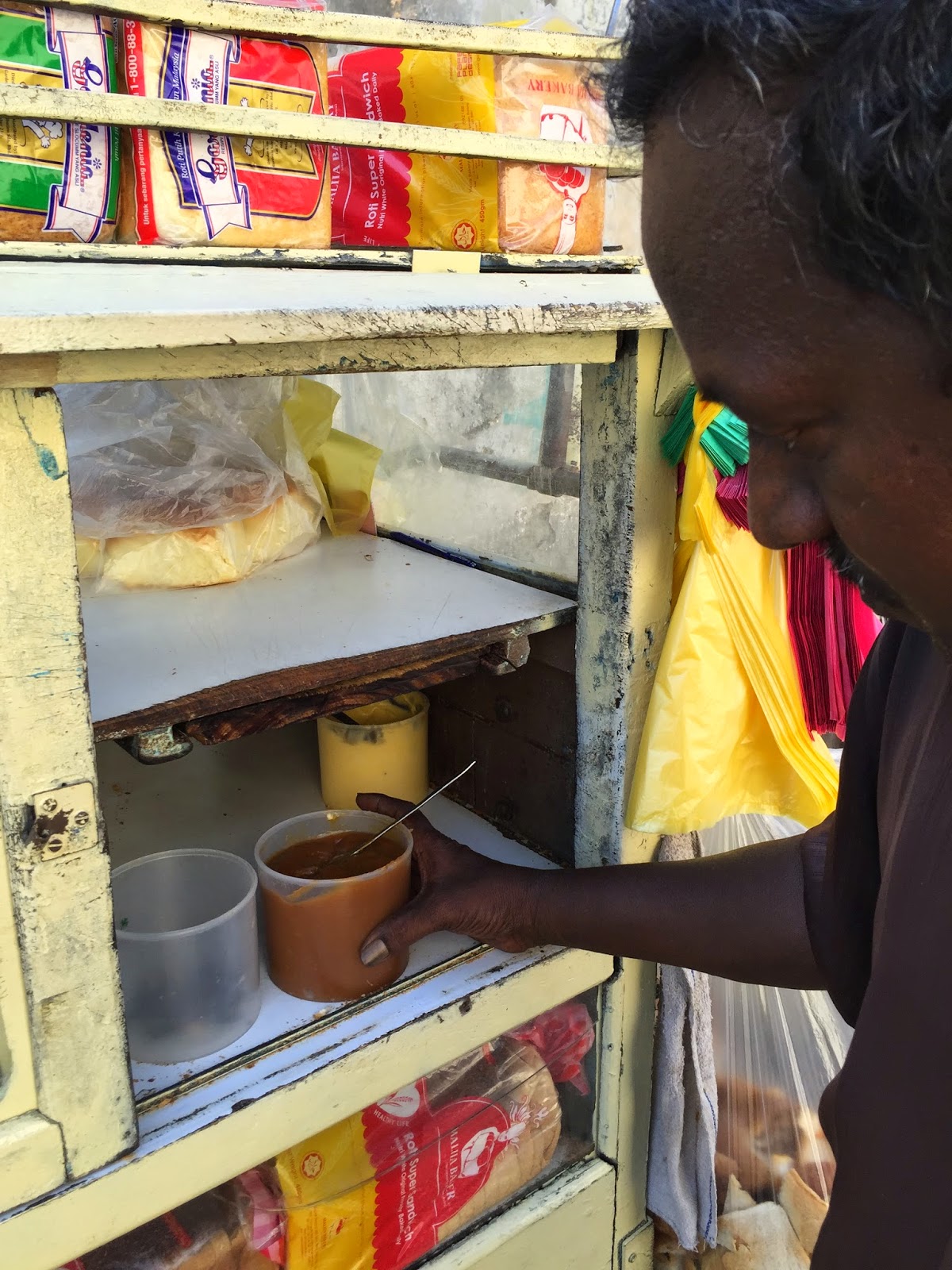
It was a pretty humid day and a yellow tricycle crawled into the back lane of Stewart Street. I'm sure that Mr Sekar, the owner of this "mobile office", had entered the lane to look for a reprieve from the blistering heat.

Me Sekar was keen to share his work. The bread on display were hygienically wrapped and were supplied by branded bread making companies. But what I was interested in was Mr Sekar's "ride". The lower cupboard stored his loaves of bread that he uses to create his mouth-watering kaya toast.

Mr Sekar shared about how he prepares the kaya toast
In the upper cupboard, Mr Sekar has his kaya and butter ready. The doors to the cupboard help to keep away the flies and dirt as he moves from street to street. As we said our farewells, Mr Sekar peddled off to hawk his "wares". There was a great sense of pride in what he does. Mr Sekar did not choose the easy way out by mounting his cupboards on motorcycles. Instead, he continues to serve the community by peddling his tricycle.  

Tricycle Bread Seller in Singapore

I asked Mr Sekar to pose with his tricycle. He did. I'm not sure if he knows that in Singapore, this trade is no longer in existence. So when was the last time we saw such a tricycle bread seller selling bread on the streets?

Well, it seems that the last captured image of such a bread seller in Singapore was in 1982.  (1) Though the mobile cupboards looked slightly different when I compared both the 1982 picture and the one that I'd taken recently, the concept of mounting these cupboards on a tricycle remains the same and Mr Sekar would not have looked out of place if we had placed him in the 1980s.

References

1. Pinsler, R. June 1, 1982. National Archives of Singapore. Retrieved on: March 19, 2015. http://www.nas.gov.sg/archivesonline/photographs/record-details/86e5aad5-1162-11e3-83d5-0050568939ad 

Sunday, October 5, 2014

[Travel] Quiet Getaway Close to Singapore

Nasi Lemak Istimewa - Malaysian Nasi Lemak at just 25 kilometres away from Singapore's Woodlands Causeway. (This is even close than from Tuas to Changi) For any travels, food always seems to be the top of our agenda. This was the case for our latest 2D1N stay at Pulai Springs Resort.

Staycation in Singapore is great, though sometimes, we just want to have something different. Somewhere that is less built up, but not too far away from Singapore.

The resort, launched in 1990s, boasts of two 18-hole USGA championship golf courses. Lovely for all those golf lovers, but what a waste, I'm not one who plays golf. So what's in store for a me? Well, I'll stick to the three Ms - Makan (To Eat), Merehatkan (To rest) and  Mengurut (To get a massage) - Please forgive my poor translation as I was trying to find words to fit into the three Ms.


Makan (To Eat)


Just feast your eyes on the picture. How can one resist such food? We had our late lunch at Gleneagles Terrace Restaurant - one of their two main restaurants. Somehow, the name Gleneagles just reminds me of our hospital back home. I'd wanted to do a little feasting at their award winning restaurant - Qing Palace Chinese Restaurant, (1) but it was closed 30 minutes before the closing time as the chefs have all gone for their break.

Aeon Taman Universiti Shopping Centre

As I had want to do some exploration, I did a 10-minute drive to Aeon Taman Universiti Shopping Centre (Previously owned by Jusco). I arrived at about 7pm and the place was Q-U-I-E-T! Well, I like it like this way. The major tenants of the mall include KFC, McDonalds and the restaurant that I ate at - Secret Recipe. Interestingly, the crowd started teeming in at about 9pm, even with their children dressed in their sleeping attires. Are they all late-night owls? I just felt like crawling into bed by then.

Merehatkan (To rest) 


That was what we did after our mini shopping and makan trip - rest. I booked the one-bedroom suite and truth be told, many of the things have indeed seen better days. Some of the switches were faulty; the safe was not working; flushing of the toilet bowl was an issue. But to be fair to them, they came by to rectify the issues as soon as they could. Still, the room could do with a bit more refurbishment. In the end, it was the serenity of this place that I enjoyed most.


Mengurut (To get a massage)


Other than food and stay, the main purpose of me being here was the massage. The resort has gone through a renaissance with special packages catering to those who intend to visit Legoland and and Hello Kitty Malaysia. There're also packages for golfing and for me, massage. One hour of full body massage and 30 minutes of foot massage really relaxed my entire body.

As a whole, it was not the best stay that I've had, neither was driving through the Causeway any more comfortable (Be prepared for at least an hour's wait at the causeway). But if you want a quick and quiet getaway, then this resort is for you to consider.

PULAI SPRINGS RESORT 20km Jalan Pontian Lama,
81110 Pulai Johor Bahru, Malaysia. Tel: 607-521 2121 Fax : 607-521 1818


1. The Straits Times. July 4, 2000. Charcoal, cockles and cruises in Bukit Merah.