So much has changed from the old Potong Pasir days. was said to have good soil for growing vegetables. Gone are the vegetable farms that were strewn across the land. But did you know that farmers had tilled the Potong Pasir land since the 1850s. The land had also produced the country's best vegetables. Vegetables that once fed 50 percent of Singapore's population. That was how important home-grown vegetables were to us, Singaporeans.
Showing posts with label Food. Show all posts
Monday, June 21, 2021
Wednesday, February 6, 2019
[Food] Bak Kwa in Nanyang
![]() |
| One of the many big Bak Kwa sellers in Singapore |
The Bak Kwa Story
Bak Kwa is said to be a Hokkien delicacy. Like many food of the past, the people had little and meat was a delicacy. Without refrigeration, How can they ensure that the meat they have can be eaten months later? Well, what the Hokkien Chinese was to slice the meat thinly, marinated them with ‘sugar and spices, air-dried and cooked over a hot plate'. It made a good treat for all at the dinner table. (9)
Bak Kwa in Singapore
It was said that Kim Hock Guan (金福源) is the very first Bak Kwa stall to set up shop in Singapore.
The late owner Mr Lim Chwee Guan had clocked in more than 50 years of barbecuing pork slices by the time he retired in 1960. (7) He located his shop at Rochore Road and together with his brother, Hock Guan were said to be "the first in Singapore to start the pork grilling business". (7)
When not in Singapore
Bak Kwa is such an important part of us. These small flavourful pieces of Bak Kwa accompanied mountaineers David Lim and Khoo Swee Chiow through their record-breaking Himalayan conques. (3) Mr Khoo even brought along Bak Kwa for his North Pole trek where he rewarded himself with two mouth-watering slices of bak kwa for every 100km that he completes. (11)
It was the same for mountaineers from the NUS Centennial when they had bak kwa fried rice while getting themselves ready for their ascent to Mount Everest. (6)
When there was no Bak Kwa, people sent on overseas missions had dreamt about it. SAF personnel who were in Acheh to help out with disaster relief for months on end had even fanned rumours that container loads of Bak Kwa were coming their way. (7)
Different Types of Meat
At times, businessmen tried to be creative such as by bringing in different types of meat - emu meat bak kwa. (1) Now, Bak Kwa comes with all kinds of meat to tickle your palate. From duck and mutton, to even crocodile meat. (4)
Day of Old
Dr Gwee Yee Hean had reminisced, 'I remember in the 1950s, when there were firecrackers, two bak kwa stores, Bee Cheng Hiang and Kim Hock Guan, which were opposite our shophouse on Rochor Road, and many other shops, too, would compete wit h one another to see who could light up more and louder firecrackers on New Year's Eve. 'Afterwards, the ground would be all red from the exploded firecrackers'. (2)
Interestingly, illegal Bak Kwa sellers were making themselves a tidy profit as late as 2002. It was critical enough for Ministry of Environment to remind the public not to buy from these vendors. (8)
Popular Culture
Bee Cheng Hiang made its presence felt in Singapore's locally-made movie - I Not Stupid. The movie, produced in 2002, talks about a Bak Kwa empire that was threatened by competition. (5)
A movie that revolved around competing Bak Kwa shops - Perfect Rival also made its debut in 2011.
Finally
The words of a Straits Times writer sums it best - "A house without bak kwa during Chinese New Year is like a firecracker without a fuse". (10)
References
1. Eat your heart out. November 12, 1997. The Straits Times. P53.
2. Leong, W. K. January 24, 2001. When traditions come and go. The Straits Times.
3. Lim, D. November 24, 1996. Terror and Triumph at the roof of the world. The Straits Times. P6.
4. Mandon, L. Z. Jan 17, 2017. 11 Weird Bak Kwa Flavours In Singapore To Skip The Queues At Lim Chee Guan. https://thesmartlocal.com/read/alternative-bak-kwa
5. The Business Times. Nothing stupid about this. February 8, 2002. P19.
6. The New Paper. May 9, 2005. Calm before storming the summit. P26.
7. The Singapore Free Press. June 3, 1960. The portly pork man with wide appeal has now retired. P19.
8. The Straits Times. February 2, 2002. Makeshift 'bak kwa' stalls not hygenic. P8.
9. The Straits Times. February 5, 2005. Fact & Fiction.
10. Tong, K. February 1, 2004. Nothing can replace bak kwa. The Straits Times. P16
11. Yeo, A. February, 2002. Bak Kwa booster for Khoo on North Pole trek. P7.
Sunday, May 21, 2017
[Food] Lai Wah Restaurant
When I first posted on Facebook about my dinner at Lai Wah Restaurant, I'd expected my friends to react to the post since this restaurant has been around since 1963. But I was pleasantly surprised that so many of them had personal stories to tell.
A few said that they or someone they knew stayed close to the restaurant. Another shared that this was his late grandmother's favourite restaurant where she'd celebrate her birthday. Yet another mentioned that he had his dinner here as his father's factory was nearby.
The recommendation of what food I should try came quick and furious - did you try the venison meat? How about the yam basket?
There were so many things we had wanted to order, just not enough space in our stomachs. So for my family of four, we ordered just four dishes - Venison fried with spring onions and ginger, garlic-fried kalan, seafood vegetable soup and their mandarin stewed chicken.
Well, the venison was indeed succulent and thinly sliced so that it's easy to chew. But the best dish was served last, and that's the mandarin stewed chicken. The stewed chicken was tender and that brought out a question from my daughter," Did they boil the chicken for long time?" I'm quite sure they did and the chicken tasted great. The chicken meat literally teared off the bones and the stew matched well with our bowl of rice.
But what is most important is that this is a heritage restaurant. One that generations have dined at. The restaurant kept to much of their 1960s origins as possible - Wooden signboard with carved gold wordings, old styled chairs and tables, and music from Teresa Teng played in the background. It was just so delightful that one can sit there and gawk at the incoming crowd. But of course, many a times you can't just walk in. You need to make a reservation in order to get a table. Yes, they are that popular. So if you have not tried their food, what are you waiting for?
Sunday, October 2, 2016
[Food] Heritage Dish of Johor: Laksa Johor
![]() | |||
| Laksa Johor [Photo Source: The Star Online] |
When I first saw the headlines, I thought it must have been one of those arguments between countries over who has the heritage rights over a certain food. Though what Johor is saying here is that they want to gazette two of their local dishes - Laksa Johor and Asam Pedas. (Musa, 2016)
State Youth, Sports, Culture and Heritage committee chairman Datuk Zulkurnain Kamisan vaguely explained the difference of Johor's Asam Pedas to that of the other Malaysian states, saying that there's a difference in terms of its "hot and spicy gravy".
Laksa Johor
It's much clearer a difference for the Laksa Johor dish. It is said that the late Sultan of Johor, Abu Bakar, visited Italy in the 1800s. After that particular trip, he came up with the idea of replacing normal noodles with Italian spaghetti.
According to Makansutra, this dish is not commonly found even in Johor as it is tedious to prepare. The website then went on to provide the addresses of places that are offering Laksa Johor.
Even in the Johor Istana, the dish is only served at "special occasions and Hari Raya celebrations" (Loh, 2016). I'm pretty sure that our Singapore Ministers would have the opportunity to try the very best of Laksa Johor when they visit the Sultan during Hari Raya.
only at special ceremonies and Hari Raya celebrations.
Read More : http://www.nst.com.my/news/2016/07/158409/rich-and-royal-taste
only at special ceremonies and Hari Raya celebrations.
Read More : http://www.nst.com.my/news/2016/07/158409/rich-and-royal-taste
So other than being a favourite dish of royalty, what else makes Laksa Johor a heritage dish? I like how this article puts it - it's a heritage dish when it helps to Bind Generations. (Ismail, 2016)
References
Ismail, S. September 22 2016. Dishes that bind generations. New Straits Times Online. Accessed on October 2, 2016. http://www.nst.com.my/news/2016/09/175063/dishes-bind-generations
Loh, P. July 15 2016. Rich and royal taste. New Straits Times Online. Accessed on October 2, 2016.
http://www.nst.com.my/news/2016/07/158409/rich-and-royal-taste
Makansutra. November 26 2013. The Royal Laksa Johor. Accessed on October 2, 2016. http://www.makansutra.com/stories/5/1029/TheRoyalLaksaJohor
Musa Z. September 30 2016. The Star Online. Johor to gazette ‘laksa’ and ‘asam pedas’ as heritage dishes. Accessed on October 1, 2016. http://www.thestar.com.my/news/nation/2016/09/30/johor-to-gazette-laksa-and-asam-pedas-as-heritage-dishes/
Labels:
Beyond Singapore,
Food,
Malaysia,
Within 100km of Singapore
Sunday, September 18, 2016
[Food] Blk 644 Hougang Mee Chian Kueh
![]() |
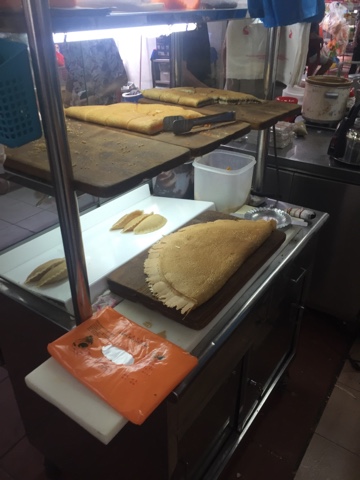
| Freshly-Made Bee Chiang Kueh |
People live and die for food. People will also defend the origins of some of these food and this peanut pancake is something that some countries in Southeast Asia and even Taiwan lay claim to.
The Chinese name it 面煎粿 (Mee Chian Kueh or Min Chiang Kueh) or Apam Balik in Malay. Though the name may be similar, the end product differ from country to country.
Peanut-filled, the traditional ones that we see in Singapore are fluffier. Seasoned opposition leader Mr Chiam See Tong is said to be a lover of this tasty snack. (1)
The Mee Chian Kueh of Hougang
![]() |
| Making the First Slice |
The timing was just perfect. Mr Lee, the owner of the Mee Chian Kueh stall at Blk 644 Hougang Avenue 8 had just put the final touches to his first batch of Mee Chian Kueh. Freshly made!
Having a go at the Mee Chian Kueh, I'd just wished that there were more grounded peanuts within. But I guess customers always want more of the best stuff.
Other Old School Peanut Pancake Stalls
Tiong Bahru Mian Jian Kueh
30 Seng Poh Road, Tiong Bahru Market
#02-34, Singapore168898
Tanglin Halt Original Peanut Pancake
48, Tanglin Halt Road, Tanglin Halt Market
Stall 16 Singapore 142048
References
1.Lee, M. K. August 23, 2015. Cheap & Good, How does Chiam See Tong's favourite peanut pancake taste? The Straits Times.
![]() |
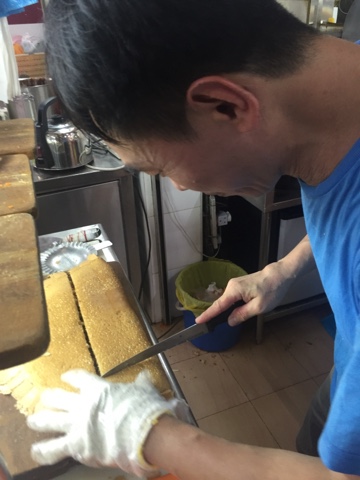
| Focused on Cutting it Right |
Having a go at the Mee Chian Kueh, I'd just wished that there were more grounded peanuts within. But I guess customers always want more of the best stuff.
Other Old School Peanut Pancake Stalls
Tiong Bahru Mian Jian Kueh
30 Seng Poh Road, Tiong Bahru Market
#02-34, Singapore168898
Tanglin Halt Original Peanut Pancake
48, Tanglin Halt Road, Tanglin Halt Market
Stall 16 Singapore 142048
References
1.Lee, M. K. August 23, 2015. Cheap & Good, How does Chiam See Tong's favourite peanut pancake taste? The Straits Times.
Sunday, June 12, 2016
[Local Brand] Chewing-gum of the Orientals
| ||
| A 2016 packaging of this local cuttlefish brand |
The tagline - "Chewing -Gum" of the Orientals is still way beyond our time. How did the makers foresaw that Singapore would ban the sale of chewing gum in 1992 and thus, they becoming the heir-apparent of all "chewing gums" was indeed quite interesting.
That said, Ken Ken Prepared Cuttlefish is still on sale in supermarkets after more than 50 years. Produced by Ken Ken Manufacturing Pte Ltd, most of their advertisements are joint promotion with major supermarkets such as Giant and NTUC. They had also formerly worked with Carrefour, Isetan and Econ Minimart.
| Straits Times, April 17, 1977. Page 15 (1) |
The cuttlefish was one of my fav snack of the 80s and though it cost quite a bit especially since I was just a little tween with only a little money in my pocket. It was popular amongst kids and they were readily available at the mamak stores.
The company is currently operating out of a factory at 20, Senoko Way. Prior to this, they were located at 324 Tanjong Katong Road. (1)
References
1. The Straits Times. April 17, 1977. Advertisement. P15.
2. The Straits Times. July 30, 1976. Advertisement. P22.
Sunday, October 25, 2015
[Singapore Islands] Pulau Ubin: Tranquil Island
Pulau Ubin - An island that is a stone-throw away from Singapore's mainland but it is so different in every way. Stepping onto the island seems to zap you into history. Nature, houses on stilts, tall coconut trees. All of which are not commonly seen on the island of Singapore.
I'd wanted to bring my family to Pulau Ubin over the weekend but the rain scuppered our plans. Also, I'd wanted to see how we can spend the least amount of money while gaining maximum enjoyment.
We started off from the Changi Point Ferry Terminal. In the past, we just waited at the pier the boatman would just call out to you to board his bumboat. Unlike now, there was no police checks or scanners. We just climb across adjoining bumboats to get to the one that was departing for Pulau Ubin.
The cost of the bumboat ride was S$2.50 per pax. It does not matter if my son was just 2 years old, as long as he can crawl, they will charge. Fair dinkum I'd say. The kids enjoyed the bumboat ride to Pulau Ubin.
It took us merely 30 minutes to get to Pulau Ubin and off we went for our walk. We took in the sights of the the Sensory Trail where different plants are grown along the trail. We even saw a well. Something that we in Singapore do not get to see anymore.
Before we head back to our beloved little red dot, we chose to fill our stomachs with some island food. So off to Pulau Ubin Seafood Restaurant we went.
Nothing fancy, we had fried rice, hor fun, a plate of vegetable and kampong chicken. All in all, we spent less than $60 for the entire trip. Good family bonding; Good value!
First published on November 30, 2011.
Sunday, October 4, 2015
[Singapore Food] Mei Ling Market & Food Centre
![]() |
| A Road Sign Pointing Customers towards the Market |
| Mei Ling Market Appeared in the 1972 map (1) |
![]() |
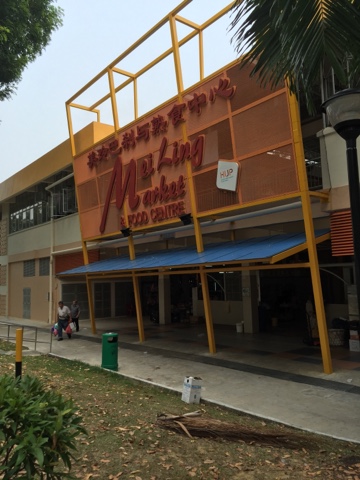
| The Entrance to the Market |
Firstly, other than the red emblazoned words at the front of the market, the structure itself looked to have changed little. The windows on the second storey are also those that one would see installed as kitchen windows in HDB blocks of the 1970s.
![]() |
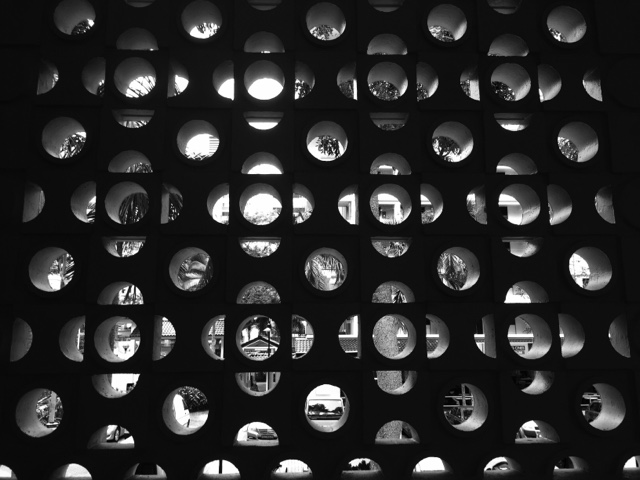
| Natural Lighting Helps to Luminate the Stairwell |
One design that caught my attention was the brick wall of the stairwell. The walls had circles and semi-circles that not only provided natural lighting for the stairwell, the design also gives this market its character.
![]() |
| Well Ventilated Food Centre |
The market major retrofitting work that was completed in 2009 (The market even has its own escalators) and both the wet market and food centre on the 2nd level have been well refurbished. Interestingly, live chickens were slaughtered in the market up until 1991 when the Environment Ministry laid down the law of not allowing such slaughter to take place. (2)
![]() |
| Trying the Fried Kuey Teow - Tan Song Heng |
I know that there are many choices of food that I can choose from at the food centre, but I was just craving for Fried Kuey Teow that day. So a plate of Fried Kuey Teow I had to get. As I'm no food connoisseur, I'll leave the description of food to the expert. In the nutshell, the Fried Kuey Teow was just alright.
I heard that the chicken rice, lor mee and prawn noodles are worth a go. Any other recommendations?
References
1. One Map. http://hm.onemap.sg/ Accessed on September 28, 2015.
2. Poultry seller at Mei Ling Street want an area to slaughter fowl. October 8, 1991. The Straits Times. P. 23.
Labels:
Food,
Housing Estates,
Local Product,
People,
Singapore
Sunday, September 27, 2015
[Buildings] Blk 74-80, Commonwealth Drive
![]() |
| Emptied Blocks of Flats |
Looking at Heritage Blogger James Seah's post about this place, this place was once full of life. It had life. There was a spritely dame of a coffeeshop, and a kindergarten with nice wall paintings. Sundry shops, hairdresser and hardware shop were all located under these blocks. Indeed it was convenient for the residents there.
![]() |
| A Towering HDB Block in the Background |
1. Old-School Mosaic Tiles
![]() |
| Mosaic Tiles Seen at Blk 74 |
2. Ground-Floor Kindergarten
![]() |
| Bright Painting Marks this Kindergarten |
In its earlier years, Commonwealth Drive had a growing number of young families. Back in those kampung days, it would have been quite an effort sending the child to school and back as educational institutions were located centrally so that everyone would have access to schools. Things started to change in the 70s. Kindergartens were now located under the HDB blocks.
I can just imagine the crackling of children's voices as they learn to read and also, play. Looking at the louvered metal-windows, I can also imagine myself as an excited parent just hoping to meet the eyes of my child. I would have mustered a peep through the windows just to see if my child is doing alright.
3. Letter-Boxes
![]() |
| Row after Row of Letter-Boxes |
One other interesting thing to note about the mailbox. The centre flap bears the unit number of your house. If you're staying on the first level and your home address is 777, then it would just be listed as 777. But if you were staying the second level, then your unit number would be 777-A, and third level 777-B. In the late 1970s, the government must have felt that it was difficult for some people and thus implemented 01-777, 02-777. The new format for address can be seen riveted on the top right corner of each letter box.
![]() |
| What an Interesting Find! |
Labels:
Buildings,
Food,
Housing Estates,
People,
Singapore
Sunday, August 23, 2015
[Local Food] Ah Hui Big Prawn Noodle
![]() |
| Prawn noodle stall formerly from Thomson's Long House |
"Hae Mee Thng; Hae Mee Ta"
When Upper Thomson Road's Long House, a place for late night supper shuttered, some stall owners retired, while others moved to other locations such as the Balestier Market.(1)
One of the stalls is the Ah Hui Big Prawn Noodle. I had not read about this stall's whereabouts. So I was pleasantly surprise to chance upon this stall and was happy to be re-acquainted with them once again. Scouring through the internet, I found that the stall had even set up their own Facebook page. I'm truly impressed by how they have used technology to keep us abreast of their stall's happenings.
Speaking to the stall auntie, she mentioned that they'd moved here in 2014 and that the rental is better here than it was at Long House. As I'm pretty much a supporter of everything local whether food, heritage or culture, I'm just glad that they chose to continue their business.
Not Just another Bowl of Prawn Noodle Soup
![]() |
| Delicious, isn't it? |
Indeed, prawn noodle soup is something that I grew up eating and seeing the stall at Balestier Market brought me much joy. I was feeling greedy that day and thus, not only did I ordered their Pork Rib Prawn Noodle Soup, I'd also asked for their handmade fishcake.
The soup stock was richly flavoured and definitely slurpalicious; the noodles had just the correct springy texture; and you can just taste the freshness of the prawns.
![]() |
| Hand-made Fishcake |
Frankly, I'm no food guru but I know that the food is wonderful when it reaches my mouth!
Stall Details
Ah Hui Big Prawn Noodle (Balestier Market)
411 Balestier Road (s) 329930
Open daily : 9am - 10:30pm
The Prawn Noodle Soup Story
It is said that the original prawn noodle soup was brought to Singapore in the 1880s by Chinese immigrants from Xiamen, Fujian Province. (2)The modern version of the prawn noodle soup is said to have been started in the 1930s by the patriarch of those who now own Beach Road Prawn Mee, Joo Chiat Prawn Mee and Jalan Sultan Prawn Mee. (3) (4)
The dish was so taste-worthy that local upmarket hotels such as Forum Hotels (Now Forum The Shopping Mall) and Peninsula Hotel were advertising their offering in the dailies in the 1970s and 1980s respectively. (5) (6)
References
1. Quek, E. March 31, 2014. Longhouse to live on in two locations. My Paper. Accessed on August 24, 2015. http://mypaper.sg/lifestyle/longhouse-live-two-locations-20140331
2. Tan, B. Hokkien Prawn Noodle Soup. Singapore Infopedia. Accessed on August 23, 2015. http://eresources.nlb.gov.sg/infopedia/articles/SIP_1807_2011-03-30.html
3. Dr Tay, L. January 28, 2010. Beach Road Prawn Mee: Order your prawn mee with no Tau Gay. i eat, i shoot, i post. Accessed on August 23, 2015. http://ieatishootipost.sg/beach-road-prawn-mee-order-your-prawn-mee-with-no-tau-gay/
4. Take stock of Goh's prawn mee tradition. October 26, 1986. The Straits Times. P4.
5. Advertisement. July 14, 1975. New Nation. P12.
6. Advertisement. May 22, 1984. The Business Times. P11.
Sunday, June 21, 2015
[Vintage Brand] Farmer Brand Peanuts
Farmer Brand Peanut or 味香園(Wei Xiang Yuan or Mei Heong Yuen) was the talk of town when I posted the photo of this can online. I took the photo of this can when I visited Cameron Highland's Time Tunnel Museum.
The peanuts are grown in the Menglembu Plains of Perak, Malaysia since the 1940s. The love relationship blossomed between Singapore and the Farmer Brand Peanut when the late-Mr Lee Chit Heng decided to move his "processing and distribution operations to Singapore in the 1950s". (1)
Mei Heong Yuen Food Industries Pte Ltd is currently located at 261, Pandan Loop, does the processing, packaging and distribution of these peanuts. (2)
This brand of peanuts has accompanied many through the decades. The public was able to purchase this brand of peanuts from various leading supermarkets and convenience stores (From the old Emporium in the 1970s to NTUC and Cheers in current times). (3)
In Singapore, peanuts are eaten for all occasions - from wedding dinners and regular restaurant dinners, to funeral wake.
Facebook user Larry Lai shared that in the past, "they even use paper-bag to pack their ground-nut if you buy small quantity".
In 1979, a bag of 227g roasted peanuts costs S$0.95. Now, a bag of peanuts comes in 150g and with multiple flavours such as Garlic and Coconut.
Here's the email interview with a representative of the Farmer Brand Peanut.
1. Where was the original shop in Singapore? [Nicholas] Also along Temple Street but not at the present unit.
2. When was the shop set up? [Nicholas] Unable to recall the year.
3. Was there only one type of peanuts commercially sold in the past? [Nicholas] Yes and it gradually expanded to more flavours.
4. Do any of the peanuts still come from Menglembu? [Nicholas] No, it is now from another country.
Updated: 25 June 2015
References
1. Tee, E. April 10, 2012. Historic Singapore: 5 Chinatown businesses that endure. http://travel.cnn.com/singapore/visit/old-shops-chinatown-748077 Accessed on June 22, 2015.
2. Singapore Chinatown Heritage Brands. http://www.farmerpeanuts.com/aboutus.html Accessed on June 21, 2015.
3. Emporium Holding Group. June 15, 1979. Super Special. The Straits Times. P7.
Sunday, May 24, 2015
Lim Tua Tow Market and Teck Chye Terrace
This was a popular market and hawker centre in the 50s and 60s. The Lim Tua Tow market was sited on the left of the picture, while the shop houses along Teck Chye Terrace are on the right.
The place surrounding the market was rather filthy and complaints were made to the government in hope that something could be done. There was no proper refuse disposal and items that were unwanted were dumped into the side drains. (17)
Not only was the place laden with filth, gangs also ply the back lanes. (5)
The market was demolished in the 1980s due to road expansion. The shop houses on he right are still currently there.
Teck Chye Terrace (Postal Code: Singapore 19/ 1954; 5 1/2 milestone Upper Serangoon Road)
Ask anyone about what Teck Chye Terrace is about and they will tell you it's all about food. From the traditional porridge stalls to buffet styled steamboats, this stretch of shophouses have different eating places to whet your appetites. (26) More recently, this row of shophouses made news as "five adjoining two-storey shophouses" were sold at a whopping cost of S$14.63m. (12)
But what was this place like before the advent of these makan places?
One of the first mention of the road name Teck Chye Terrace was seen in a 1930 Straits Times article. Police raided 19 Lim Teck Chye Terrace, Paya Lebar Village and arrested 10 Chinese for gambling. (13). Other vice activities included taking "chandu" or opium. (16)
Teck Chye Terrace was acquired by the government in 1931 and declared as a public street. (6) The owners of the freehold land was selling buildings No.1 to 17 - Odd numbers. This road was already present in 1929. (7) It was purchased by a Mr Lim Soo Sian for a princely price of $22,000. (14)
After the Japanese occupation, the Christian community from Paya Lebar Methodist Church pumped in money to build a children's playground close to Teck Chye Terrace, adding some joy to these younglings. The area where the playground was to be built was said to be "overgrown with weeds, banana plants, and bushes and is a dumping ground for scrap and timber". (15)
Adding to gang activities, the filthiness of the place and mosquitoes infestations, Teck Chye Terrace was not a place where families would want to make this place their home. (18)
![]() |
| Source: OneMap, 1954 |
In 1962, one of its residents named Teck Chye Terrace as "one of the filthiest roads in Singapore". The road was totally crowded with "more than 100 stalls illegally constructed obstruct road users". (8) There was even a call to move these stall holders into the existing market and vacant playground. (3)
Companies that used the buildings at Teck Chye Road include:-
a. Hong Huat Timber Merchant in 1974 at 41, Teck Chye Terrace(9)
b. There was a slew of retail and wholesale liquor and beer shop that applied for a joint licence under the Singapore Provision Shop Friendly Association in 1975. These provision shops included 3, 9, 21, 27, 31, 33, 37 Teck Chye Terrace. (19) (20) (21) (22)
c. Hong Lee Goldsmith at 13 Teck Chye Road (11) (23) from 1982-91. The shop was then named Tiara Creation Pte Ltd in 1991. (27)
d. the now defunct Serangoon Sewing Machine Co. at 33, Teck Chye Terrace (10) in 1982-89. The company went on to sell other electrical appliances such as coloured television, video recorder and hi-fi sets. (24) (25)
First written on May 13, 2014.
Updated on May 31, 2015.
References
1. Left photo: From the Lee Kip Lin Collection. All rights reserved. Lee Kip Lin and National Library Board, Singapore 2009
2. Right photo: Google Map. Retrieved on May 13, 2014.
3. The Straits Times. May 22, 1963. Filth and Dust. P8
4. The Singapore Free Press and Mercantile Advertiser. March 16, 1932. P2.
5. The Straits Times. The gangs like the dark. October 11, 1955. P8.
6. The Singapore Free Press and Mercantile Advertiser. Declining Property Value. August 17, 1932. P12.
7. The Singapore Free Press and Mercantile Advertiser. September 28, 1929. Municipal Commission. P11.
8. The Straits Times. Top prize for squalor. July 21, 1962. P10.
9. The Straits Times. Advertisement. December 9, 1974. P25.
10. Singapore Monitor. November 21, 1984. P3.
11. The Straits Times. Advertisements. June 14, 1983. P23.
12. Rashiwala, K. March 5, 2015. Mortgagee sales lift number of auction properties in Jan-Feb. The Business Times. Retrieved on May 31, 2015. http://business.asiaone.com/news/mortgagee-sales-lift-number-auction-properties-jan-feb
13. The Straits Times. Caught Gambling. January 30, 1930. P17.
14. The Singapore Free Press and Mercantile Advertiser. April 27, 1932. Property Sale. P7.
15. The Straits Times. April 2, 1948. Paya Lebar Plans Centre. P5.
16. The Singapore Free Press and Mercantile Advertiser. January 13, 1938. Had two cards: opium smoker fined. P15.
17. The Straits Times. January 29, 1955. Even the city cleaners don't dally here. P12.
18. The Straits Times. August 26, 1957. Back lanes need watching. P6.
19. New Nation. January 8, 1975, Advertisements. P15.
20. New Nation. January 29, 1975, Advertisements. P16.
21. New Nation. February 6, 1975, Advertisements. P21.
22. The Straits Times. January 4, 1975. Advertisements. P18.
23. The Straits Times. November 20, 1982. Goldsmith jailed for cheating another goldsmith of $20,000. P8
24. The Straits Times. July 22, 1984. Advertisements. P6.
25. The Straits Times. August 25, 1985. Advertisements. P23.
26. The Straits Times. December 11, 2005. Mass Market it is. Retrieved on May 31, 2015.
27. The New Paper. June 6, 1991. Advertisements. P29.
Labels:
Food,
Historical Site,
Local Product,
People,
Singapore
Sunday, April 19, 2015
[Food] 328 Katong Laksa
![]() |
| 328 Owner Ms Lucy Koh dictates her business at the entrance of her shop |
With her well coiffed hair and neat dressing, Ms Lucy Koh easily stood out from the rest of her staff. She guards the front of her shop like a hawk and none of her staff was allowed close to her special formulated laksa gravy when she's around. No one except when she was away dishing out her laksa to Singaporeans in Shanghai, China every year during Singapore Day. (1)
![]() |
| Fresh cockles in the bowl of laksa |
As I was visiting the shop under National Heritage Board's HeritageFest 2015, I did not have the opportunity to have a go at the laksa but was just happy to have the opportunity to speak with Ms Koh. (2) But I was not deterred and had returned to the shop for dinner.
![]() |
| The crowd was just starting to build up when I was there at 10am |
Ms Koh was quietly confident that she has one of the best laksa formula in town - her laksa won Gordon Ramsay's version hands-down. (3) This media savvy boss sees good online reviews of her laksa on sites such as Lonely Planet and ieatishootipost. (4) (5)
Previously, there were a number of pioneer laksa stalls in Katong. i.e. Janggut Laksa. But now, it looks like 328 Katong Laksa has now the monopoly of the laksa business there.
So how good is 328 Laksa? Is Janggut Laksa a worthy rival? (6)
Or maybe one that's outside of Katong - Sungei Road Laksa?
References
1. Singapore Day 2015 Shanghai. Accessed on April 18, 2015. https://www.singaporeday.sg/hawker.html
2. Heritagefest 2015. Accessed on April 18, 2015. http://heritagefest.sg
3. Hungrygowhere. Accessed on April 18, 2015. http://www.hungrygowhere.com/dining-guide/hawker/gordon-ramsay-wins-chilli-crab-loses-hawker-heroes-challenge-*aid-8b773f00/
4. 328 Katong Laksa. Lonely Planet. Accessed on April 18, 2015. http://www.lonelyplanet.com/singapore/restaurants/indonesian/328-katong-laksa
5. ieatishootipost. Accessed on April 18, 2015. http://ieatishootipost.sg/328-katong-laksa-hits-you-right-there-yeah-yeah-yeah/
6. Janggut Laksa: Original Katong Laksa. http://singapore-trails.blogspot.sg/2014/11/janggut-laksa-original-katong-laksa.html
7. Sungei Road Laksa. http://singapore-trails.blogspot.sg/2014/09/sungei-road-original-laksa.html
Sunday, March 22, 2015
[Special Edition] People, Places, Penang - Wonton Mee
![]() |
| Wonton noodles from three different stalls |
Three days in Penang, three tries of wonton noodles. It was paradise. The dish or at least the wonton originated from Canton, China and how it's cooked and the ingredients differ from country to country. (1)
One thing for sure is that wonton noodle can be found in countries where there is a Chinese diaspora, such as Singapore, Malaysia, Hong Kong and China.
In Penang, we tried out the wonton noodles from three different places. There is a similarity amongst all three noodles from Penang as all stallholders used dark sauce for seasoning.
I have to say that I'm no food connoisseur but I still have my preference. So here're the three wonton noodles stalls that we had sunk our teeth in. 1. From Gurney Drive Food Centre (Top); 2. CF Hawker Centre along Armenian Street (Left), and 3. the nondescript wonton noodles stall along King Street(Right).
Well, Surprise Surprise, the winner is the one from the nondescript stall! So here's what I think of each of the stall.
1. Gurney Drive Food Centre
Business at Gurney Drive was brisk though the queue to order a bowl of wonton noodle was negligible. The lady owner asked me what I had wanted in pretty fluent English. Actually, all the hawkers that I ordered my food from could speak pretty decent English as Gurney Drive Food Centre caters to both the locals and to no small extent, the foreigners.
I can say that this stall puts together a well decorated bowl of wonton noodles. There even threw in a fried wonton, not for free of course but with an additional charge of RM1. I did not like it as I was not asked if I'd wanted the fried wonton. But small matter. Though the noodles here are the most expensive amongst the three stalls.
2. CF Food Court
CF Food Court sits at the junction of Armenian and Victoria Streets. There are numerous stalls selling everything from seafood to fried noodles. We chose a table that was closest to the wonton noodle stall. Other than the char siew and vegetables that comes with wonton noodles, the stall had also added chicken strips.
3. Nondescript wonton noodles stall
I'd just finished my walk around Fort Cornwallis and had asked the counter staff where I could get food. He pointed me towards Wisma Great Eastern building which I could see from the fort. The staff mentioned that I could either choose to eat at the mamak stalls or the various coffee shops around that vicinity.
I tentatively made my way towards the junction of King Street and Bishop Street, not sure of what I'd come across.
The wonton noodles stall was located at the entrance way of the coffeeshop and was run by a family - a husband and wife team, plus their daughter. The man who was preparing the noodles had that peaceful smile on his face. I could see that he is putting in his full love and care for each bowl of noodles that he prepared. Un-rushed by the hustle and bustle of the happenings around him.
Even though his was considered somewhat of a roadside stall, I was comforted by the fact that everything at his stall was pretty clean and well maintained. His zen-ish way took over me and when I was told by his daughter that I would need to wait for 15 minutes to get my noodles, I obliged.
The dipping of noodles into hot, cold then hot water helped to lock in the taste of the springy noodles. When I received my noodles, it was nicely tied up using a thin raffia string. It took me another 15 minutes to get back to the hotel room and even then, the noodles were still springy and nice.
No doubt the loving touch of this uncle made the taste of wonton noodles all so different.
References
1. Wong, J. April 6, 2000. History of wonton noodles wins praise. South China Morning Post. http://www.scmp.com/article/313152/history-wonton-noodles-wins-praise Accessed on: March 21, 2015.
Wednesday, March 18, 2015
[Special Edition] People, Places, Penang - The Tricycle Bread Seller
I may be asked about the rationale for writing a piece about a foreign island i.e. Why Penang Island rather than Singapore since my blog is called Singapore Trails. Is this a deviation from my original purpose of writing about Singapore?
Well, yes and no. You see, purists would say that Penang Island is no Singapore. But there are many similarities between these two islands, MANY! Penang is also a place where I can extrapolate what life was like in Singapore - the way we lived, the food we ate and the streets that we walked.
Penang Island is just about an hour plane ride from Singapore and we are privileged to be situated close to Georgetown, Penang, a UNESCO World Heritage Site. Being listed as a heritage site means that its architecture and cultural landscape will be largely protected against the rapid modernisation of towns and cities. In fast-paced Singapore, we can only catch hold of whatever remaining bits of heritage that we can hold on to.
Let me begin my story of Penang with the Tricycle Bread Seller.
The Tricycle Bread Seller
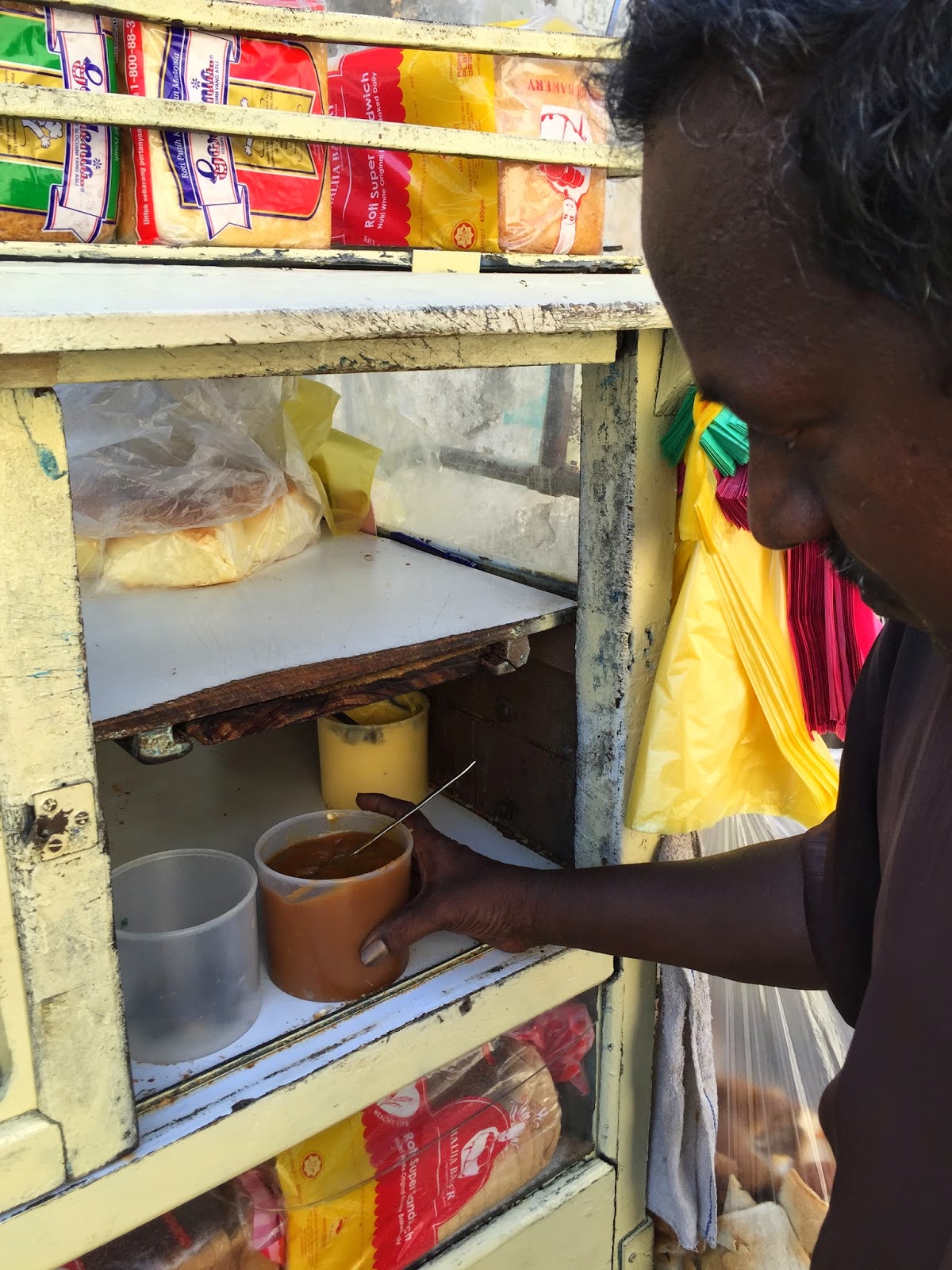
It was a pretty humid day and a yellow tricycle crawled into the back lane of Stewart Street. I'm sure that Mr Sekar, the owner of this "mobile office", had entered the lane to look for a reprieve from the blistering heat.
Me Sekar was keen to share his work. The bread on display were hygienically wrapped and were supplied by branded bread making companies. But what I was interested in was Mr Sekar's "ride". The lower cupboard stored his loaves of bread that he uses to create his mouth-watering kaya toast.
In the upper cupboard, Mr Sekar has his kaya and butter ready. The doors to the cupboard help to keep away the flies and dirt as he moves from street to street. As we said our farewells, Mr Sekar peddled off to hawk his "wares". There was a great sense of pride in what he does. Mr Sekar did not choose the easy way out by mounting his cupboards on motorcycles. Instead, he continues to serve the community by peddling his tricycle.
Tricycle Bread Seller in Singapore
I asked Mr Sekar to pose with his tricycle. He did. I'm not sure if he knows that in Singapore, this trade is no longer in existence. So when was the last time we saw such a tricycle bread seller selling bread on the streets?
Well, it seems that the last captured image of such a bread seller in Singapore was in 1982. (1) Though the mobile cupboards looked slightly different when I compared both the 1982 picture and the one that I'd taken recently, the concept of mounting these cupboards on a tricycle remains the same and Mr Sekar would not have looked out of place if we had placed him in the 1980s.
References
1. Pinsler, R. June 1, 1982. National Archives of Singapore. Retrieved on: March 19, 2015. http://www.nas.gov.sg/archivesonline/photographs/record-details/86e5aad5-1162-11e3-83d5-0050568939ad
Well, yes and no. You see, purists would say that Penang Island is no Singapore. But there are many similarities between these two islands, MANY! Penang is also a place where I can extrapolate what life was like in Singapore - the way we lived, the food we ate and the streets that we walked.
Penang Island is just about an hour plane ride from Singapore and we are privileged to be situated close to Georgetown, Penang, a UNESCO World Heritage Site. Being listed as a heritage site means that its architecture and cultural landscape will be largely protected against the rapid modernisation of towns and cities. In fast-paced Singapore, we can only catch hold of whatever remaining bits of heritage that we can hold on to.
Let me begin my story of Penang with the Tricycle Bread Seller.
The Tricycle Bread Seller
| In The back alley of Stewart Street |
It was a pretty humid day and a yellow tricycle crawled into the back lane of Stewart Street. I'm sure that Mr Sekar, the owner of this "mobile office", had entered the lane to look for a reprieve from the blistering heat.
Me Sekar was keen to share his work. The bread on display were hygienically wrapped and were supplied by branded bread making companies. But what I was interested in was Mr Sekar's "ride". The lower cupboard stored his loaves of bread that he uses to create his mouth-watering kaya toast.
| Mr Sekar shared about how he prepares the kaya toast |
Tricycle Bread Seller in Singapore
I asked Mr Sekar to pose with his tricycle. He did. I'm not sure if he knows that in Singapore, this trade is no longer in existence. So when was the last time we saw such a tricycle bread seller selling bread on the streets?
Well, it seems that the last captured image of such a bread seller in Singapore was in 1982. (1) Though the mobile cupboards looked slightly different when I compared both the 1982 picture and the one that I'd taken recently, the concept of mounting these cupboards on a tricycle remains the same and Mr Sekar would not have looked out of place if we had placed him in the 1980s.
References
1. Pinsler, R. June 1, 1982. National Archives of Singapore. Retrieved on: March 19, 2015. http://www.nas.gov.sg/archivesonline/photographs/record-details/86e5aad5-1162-11e3-83d5-0050568939ad
Labels:
Beyond Singapore,
Food,
Local Product,
People,
Transportation,
Vanishing Trade
Sunday, January 11, 2015
Bendemeer Housing Estate: Old World Charms
Bendemeer Housing Estate - One that saw the housing of families in the 1970s where many found jobs within the nearby Bendemeer Industrial Estate. In 2007, the government put the housing estate through an upgrading programme to spruce it up. (1)
Still, the housing estate has somehow managed to keep some of its original charm. Located just a stone's throw away from Boon Keng MRT station, here're 5 good reasons why you should visit this housing estate.
1. Are You a Heritage Buff?
Stepping out of Boon Keng MRT, one of the first things that will catch your eyes would be an information board to start you on your exploratory journey. Read about the famous Whampoa and go on a search to locate the original site of the once-famous Nam Sang Fu Un. After the passing of Whampoa, the property was purchased by a prominent Teochew, Seah Liang Seah and he went on to re-name the building Bendemeer House.
2. Teochew Restaurants Galore
This brings us to another reason why you should visit Bendemeer Housing Estate - The Teochew food. In this Teochew enclave that sees only 12 buildings, there are three Teochew restaurants.
Yuan Xing Teochew Restaurant - The business first started at Wayang Street in the 1950s. They moved to the current site in 1972. (2)
Liang Kee Teochew Restaurant - A restaurant that started in the 1968, this restaurant has been given a pretty good rating by a famous food blogger, Dr Leslie Tay of the ieatishootipost fame. (3)
Ban Heng@Boon Keng - This is a Ban Heng group of restaurant that also serves Teochew cuisine.
So there, three 'branded' teochew restaurants for you to choose from.
3. Knick-Knack Shops
4. Get a Hair-Cut on the Go
Other than the many Teochew restaurants, there are also many barbers and hair-dressers. Just take a look at the picture above - Louisa Permanent Wave. The word Permanent Wave just conjures up the image of that cylindrical contraption that give you the hardest perm you can ever have. This shop still retains the old unit number where it does not list the level. i.e. 673 instead of 01-673. "One karipok haircut, please!"
If you want good food, you get good food. All at the Bendemeer Market and Hawker Centre. The variety of food is just mind-blowing. I had a go at a plate of carrot cake but as soon as I sat down with my food, my eyes started to rove around for other good spoils.
References
1. Bendemeer all spruced up now. January 15, 2007. The Straits Times. P28.
2. Yuan Xing Teochew Restaurant. October 3, 2009. Today. P41.
3. Liang Kee Teochew Restaurant: Teochew Chef Behind the Wok. http://ieatishootipost.sg/liang-kee-teochew-restaurant-teochew-chef-behind-the-wok/ Retrieved on: January 11, 2015.
Labels:
Food,
Housing Estates,
Local Product,
People,
Shopping,
Singapore
Subscribe to:
Posts (Atom)