Sunday, September 18, 2016

[Food] Blk 644 Hougang Mee Chian Kueh

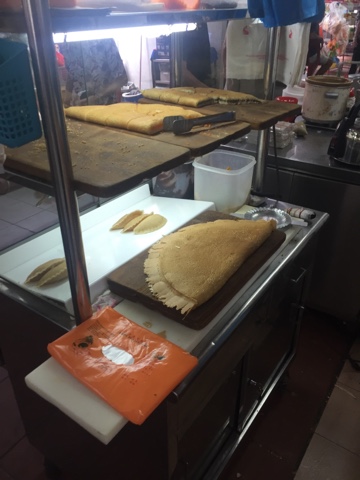
Freshly-Made Bee Chiang Kueh

People live and die for food. People will also defend the origins of some of these food and this peanut pancake is something that some countries in Southeast Asia and even Taiwan lay claim to.

The Chinese name it 面煎粿 (Mee Chian Kueh or Min Chiang Kueh) or Apam Balik in Malay. Though the name may be similar, the end product differ from country to country.

Peanut-filled, the traditional ones that we see in Singapore are fluffier. Seasoned opposition leader Mr Chiam See Tong is said to be a lover of this tasty snack. (1)


The Mee Chian Kueh of Hougang

Making the First Slice

The timing was just perfect. Mr Lee, the owner of the Mee Chian Kueh stall at Blk 644 Hougang Avenue 8 had just put the final touches to his first batch of Mee Chian Kueh. Freshly made!

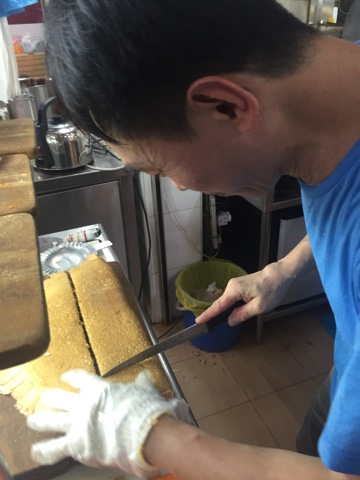
Focused on Cutting it Right


Having a go at the Mee Chian Kueh, I'd just wished that there were more grounded peanuts within. But I guess customers always want more of the best stuff.

Other Old School Peanut Pancake Stalls

Tiong Bahru Mian Jian Kueh
30 Seng Poh Road, Tiong Bahru Market
#02-34, Singapore168898

Tanglin Halt Original Peanut Pancake
48, Tanglin Halt Road, Tanglin Halt Market
Stall 16 Singapore 142048 

References

1.Lee, M. K. August 23, 2015. Cheap & Good, How does Chiam See Tong's favourite peanut pancake taste? The Straits Times.

Sunday, September 4, 2016

[Art] Singapore's $50 note: A work of Art


Do you realise that many of us have been carrying around works of art in our wallets and purses and yet not know it? Well, I came to realise this truth only after visiting the National Gallery Singapore.

Opened in 2015, the gallery is located within the Old Supreme Court building and the City Hall. The gallery houses the largest collection of Singapore and Southeast Asian art collection.

Now let's get back to the crux of the matter - our $50 note.

If you were to take a look at the reverse side of the Singapore $50 note, you will see two very distinct work of art. One is of gibbons by artist Chen Wen Hsi, and the other are of people in the market with hanging dried fishes by Cheong Soo Pieng. Both of these paintings are now housed in the National Gallery Museum.


Chen Wen Hsi's Gibbons. Picture source: arthop.co (1)

Cheong Soo Pieng's Drying Salted Fish. Picture source: Straits Times (2)


References

1. Hong, G. April 1, 2015. Lee Kuan Yew: The man and his art. http://www.arthop.co/blog/lee-kuan-yew-man-and-his-art

2. Ong, S. F. November 30, 2015. 7 things to know about Singapore pioneer artist Cheong Soo Pieng. The Straits Times. http://www.straitstimes.com/lifestyle/arts/7-things-to-know-about-singapore-pioneer-artist-cheong-soo-pieng

Monday, August 29, 2016

[Transportation] Road Tax disc: 3 things that you may not know about this piece of paper


In today's news report, the Land Transport Authorities (LTA) has rung the death kneel on Road Tax Disc. Come February 15 next year, motorists will not be required to display road tax discs on the windscreen of their vehicles. (1) For years, this is one piece of paper that had accompanied all road worthy vehicles in Singapore. Failure to display a proper road disc, or putting up an expired one, had seen fines being meted out to these motorists.

Soon, motorists can keep their windscreen clear of clutter. If not, at least one lesser piece of paper to be pasted on the windscreen. But what are the interesting facts about this small but important piece of paper?

1. Where are road tax discs positioned on the windscreen?

It is by law that road tax dics are positioned on the left of the windscreens.

In a forum reply dated January 11, 1969, the secretary of the Automobile Association of Singapore brought up the Road Traffic Ordinance - Motor Vehicles (Registration and Licensing) Rules Part II, No.28 where it reads "The licence shall be carried...on the left side of the vehicle facing towards the near side of the road." (2)

The rule was updated in 1972 to ensure that the wording as to how to place the disc clearer.

"The road tax should be placed at the left lower corner of the windscreen facing forward so as to be clearly visible from the front at all time whether the vehicle is moving of stationary". (3)


2. Were there instances where motorists were fined for not displaying the road tax disc?

Indeed. In 1971, a Mr Tan was fined S$20 for not displaying his Registry of Vehicle (ROV) tax disc (4)  while in 1970, a Mr Quek was fined S$30 for driving with an expired road tax disc. (5) Both of the men were caught in 1968. It seemed that after more than two years, the courts had wanted to get hard on these motorists and to show the importance of displaying the road tax disc in a proper manner.


3. Did the rule of displaying the road tax disc on the left of the windscreen worked for everyone?

Well no. In 1969, a motorist questioned this decision as at that time, there were left-hand drive cars. The motorist said that it would obstruct the view of drivers if the road tax disc was displayed on the left. (6)   


References

1. Road tax disc to be phased out from February next year. August 29, 2016. Channel News Asia. http://www.channelnewsasia.com/news/singapore/road-tax-discs-to-be/3081860.html
2. Right place for that 'tax disc. January 11, 1969. The Straits Times. P16.
3. Her tax disc was too high. december 1, 1975. New Nation. P5.
4. Tax disc fine. April 28, 1971. The Straits Times. P9.
5. Road tax fine. October 6, 1970. The Straits Times. P8.
6. Untitled. January 15, 1969. The Straits Times. P10.


Tuesday, July 26, 2016

[Buildings] Jurong Country Club: Another One Bites The Dust

Main building of Jurong Country Club


By November 2016, Jurong Country Club will be no more. This was announced in 2015 where the government will be acquiring the country club to establish the High Speed Rail Terminus between Singapore and Malaysia. (1)

Lush golf course

I for one, had wanted to see the place before it demolition. Entering the country club somehow brings forth the feeling of serenity. It was all so quiet and peaceful.

Having a Meal at the golfers' Terrace

The Cafe Does a Good Ribeye

Stained Glass Entrance

References

Lim, J. May 12, 2015. Golf club to make way for high-speed rail terminus. Straits Times. https://www.mfa.gov.sg/content/mfa/media_centre/singapore_headlines/2015/201505/headlines_20150512.html


Sunday, June 12, 2016

[Local Brand] Chewing-gum of the Orientals

 
A 2016 packaging of this local cuttlefish brand

The tagline - "Chewing -Gum" of the Orientals is still way beyond our time. How did the makers foresaw that Singapore would ban the sale of chewing gum in 1992 and thus, they becoming the heir-apparent of all "chewing gums" was indeed quite interesting.

That said, Ken Ken Prepared Cuttlefish is still on sale in supermarkets after more than 50 years. Produced by Ken Ken Manufacturing Pte Ltd, most of their advertisements are joint promotion with major supermarkets such as Giant and NTUC. They had also formerly worked with Carrefour, Isetan and Econ Minimart.

Straits Times, April 17, 1977. Page 15 (1)
The company had gone through an expansion in 1977 where they purchased Pon Pon cuttlefish. Other than the trademark, Ken Ken also took over the Pon Pon's factory space over at Chin Bee Road. (2)

The cuttlefish was one of my fav snack of the 80s and though it cost quite a bit especially since I was just a little tween with only a little money in my pocket. It was popular amongst kids and they were readily available at the mamak stores. 

The company is currently operating out of a factory at 20, Senoko Way. Prior to this, they were located at 324 Tanjong Katong Road. (1)


References

1. The Straits Times. April 17, 1977. Advertisement. P15.

2. The Straits Times. July 30, 1976. Advertisement. P22.

Sunday, April 10, 2016

[Singapore Movies] Kallang Roar! Only at the National Stadium


Singapore's National Stadium - taken in 2010

The chant rang out loud amongst the Singapore soccer players of the 70s. It was a shout of intent; A shout of believe.

"Untuk Bangsa Dan Negara", Uncle Choo Seng Quee with his voiced raised. That was quickly followed up by the players shouting with conviction - "MAJULAH"!

Singapore soccer players fought tooth and nail for just one reason - National Pride. The phrase "Untuk Bangsa Dan Negara" as translated in English means "For the people and country". Not only was it meant to bring together soccer players of different races and religions, it was also reflective of how a young Singapore was at that point in time and their aspiration of wanting to fight together, regardless of race, language or religion.


Kallang Roar: The Movie

The movie - Kallang Roar - brought back wonderful memories of yesteryear. Those time where stood together as one to cheer on our soccer team. Part of the location was filmed in the old National Stadium, which has since been demolished and replaced with a spanking new stadium. Led by veteran actor Lim Kay Siu who took the role Singapore's most successful and controversial coach,  Uncle Choo Seng Quee, the movie cast its focus on Singapore's soccer glorious days of the 70s.

Worth a watch to know the history. 

The National Stadium

Here're more photos of the stadium that I took in 2010 before it was torn down.

Both tears of joy and sadness were shed here
People of all walks of life going through the gates to watch their soccer stars
A view from inside the ticketing booth

Sunday, April 3, 2016

[Transportation] Singapore Traction Company: A Bus Company That Served Singaporeans

Three different-valued STC bus tickets that I'd purchased previously

"You must have not taken a STC bus before", said an elderly man who was waiting patiently behind me to board a re-modelled Singapore Traction Company's (STC) public bus. Indeed, I had not had a ride in one as I was a 1973 baby. STC went into debt and was sold off in 1971. (1)

Boarding a STC bus
Frontal View of the STC bus
Four circled-round lights; Rivets used to hold the shell of the bus together; a singular gear stick; The re-modelled bus was painstakingly put together by the Singapore's statutory board - the Land Transport Authority.

In the past, the assembly of such buses was taken on by local companies such as Lee Kiat Seng Private Limited. (2)  This company was previously located at 50, Kallang Pudding Road. (3) They have been building the bodies of buses since 1924. (4)

Inside of the bus

View from the driver's seat
In the past, the driver's role was just as their designation suggests - drive. The conductor job was then to help to collect the fare. I'll always remember how the conductor will use the ticket puncher to tap on the metal ticket holder, signifying that he's about to collect the fare.

Where people once smoked on board buses
There were also a number of old notices that were included in this STC bus. One, to warn passengers against smoking and the hefty fine that would come along with it. The other notices include one that advised passengers not to stand on the steps (Many still did) and the other was about an emergency door.

Fine specimen of a bus, I'd say.


References

1. Singapore Traction Company begins operation. History.sg. Accessed on April 3, 2016. http://eresources.nlb.gov.sg/history/events/51e3da00-2cdf-43a2-a548-5581d2db3e64

2. Assembly of Singapore Traction Company Nissan bus body at Lee Kiat Seng Private Limited. National Archives of Singapore. Accessed on April 3, 2016. http://www.nas.gov.sg/archivesonline/photographs/record-details/341a0d3e-1162-11e3-83d5-0050568939ad

3. Advertisement, Column 2. July 6, 1962. The Straits Times. P6.

4. Agents appointed for tube investments. June 16, 1964. The Straits Times. P13.