Sunday, May 17, 2015

A Ride Through the Years

Wonderful bus exhibition by the Singapore School and Private Hire Bus Owner Association

Today in Singapore Trails, I visited the bus exhibition at Pek Kio Community Club. I read about this exhibition and I thought back to those years where my parents brought me and my sisters around via public transport. 

The Leyland brand of public buses, ticket clipper and bus sign

Frankly, public buses has been a part many people's lives. I remember the bus brand - Leyland. I remember the thin-rod gear stick that sometimes, the bus drivers found it hard to engage. I remember the bus conductors using their ticket clippers to knock on their ticket holders to get the attention of those who have yet to pay their fare to pay up. I remember the fogged-up bus windows whenever it rained and where we were forced to shut all windows, barring those that were stuck. I remember my first bus ride, bus number 62 that brought me to my school in Geylang. That was also a time that I bawled my eye out as I could not reach the bell because I was way too short to press the red bell strip found on the ceiling of these buses.

Trolley buses

Trolleybuses used during the Japanese Occupation

There were pictures of trolley buses used during the Japanese Occupation. During that time, electricity would have been at a premium and thus a ride in these trolley buses would not be within reach of the common man.  It was also shared that charcoal buses (Burning of charcoal to power the buses) were also used.

After the war, the Singapore Traction Company started its trolley bus service in 1946. The last of the trolley bus service was taken off the road in 1962. So no more ugly-looking overhead wires. (1)

Bus Tickets
 
Bus tickets from the different bus companies
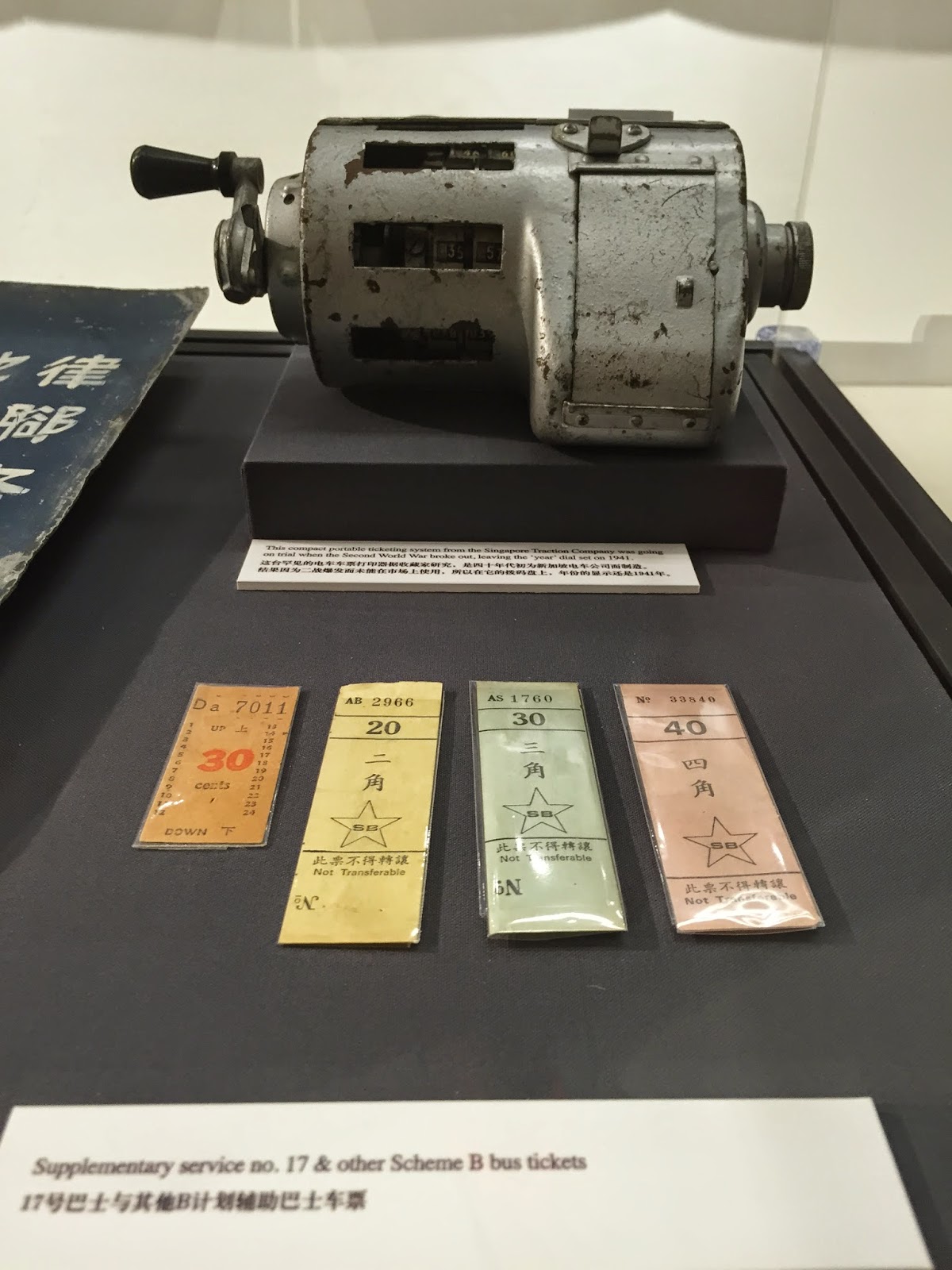
The bus tickets were all so colourful. Different colours signifying the different prices that one paid based on the planned distance travelled. There are the single coloured bus ticket for students, while the adults have the tiered-pricing tickets based on distance. I used to collect heaps of these.

Different tickets and the old bus ticket stamp

Bus Signs

Hand-written signs placed on both the front and side of the bus


Updated: November 20, 2016


References

1. Off for good: S’pore trolley buses (December 16, 1962). The Sunday Times, p. 15. Retrieved from NewspaperSG.

Sunday, May 10, 2015

Phoenix Park: The Walls Have Ears

The Main Gate of Avondale Grammar School

This was a Heritage Festival Tour that was top on my to-do list. This is one place that we cannot just walk in to visit. It has been this way ever since the ground was occupied by Singapore Japanese Golf Club from 1930. (1)

The Japanese team was a keen player of the game. They had competed against other foreign-based teams since 1930 and their final competitive game was against Johor in 1941, just before the war. (2) Other teams the Japanese team had played against were the British, Americans and also British Municipals. (2)  

Looking out from the window

When Japanese took over Singapore in 1942, the Japanese ordered the Allied Forces to surrender their weapons at the Golf Club. (3)

The 'silent' corridor of Phoenix Park Camp

Post-1945

The complex was erected in 1949 and was designed by the architectural firm Messrs Palmer and Turner. It was called “Phoenix Park” as the British’s Southeast Asia Command  was located there and their emblem was of a mythical bird.(4)

Phoenix Park had also housed the who's who of the post-war British government. The offices of the Commission General, the Commander-in-Chief Far East and the Far East Defence Secretariat were all based there. (4) (5)

There were also other critical services that based themselves at Phoenix Park. such as the Regional Fisheries Representative of the Food and Agriculture Organisation. The organisation later moved themselves to Bangkok. (6) 

The British left Singapore in 1971. The Internal Security Department (ISD) made 318 Phoenix Park their home in 1976 and shortly after in 1977, the Ministry of Home Affairs (MHA) also set up their headquarters there. Both ISD and MHA moved out of Phoenix Park by 2002. (7) (8)

The Visit

Brilliant re-enactment of the rice talks by students from the Avondale Grammar School

The doors of 318 Phoenix Park was opened to public for the first time. Both the staff and students from Avondale Grammar School, who school was located within this historic building, were wonderful hosts. The students, some of them as young as six-years old, brought to life historical milestones through their re-enactment. One was about the critical rice talks that was held in that building. The purpose was to ease the post World War 2 rice shortages in that region. (8)  

The Southeast Asia Treaty Organisation (SEATO) talks

Another re-enactment by the students was the Southeast Asia Treaty Organisation (SEATO) talks that was held in the 1950's. Countries came together to find ways of how to stop the communist threat in that region.(8)

All in, it was a really lovely visit to this historical building.


References

1. To-morrow golf at Tanglin. April 11, 1941. The Singapore Free Press and Mercantile Advertiser (1884-1942).  P12.

2. Municipal golf team to play Japanese. March 11, 1939. The Singapore Free Press and Mercantile Advertiser (1884-1942).  P10.

3. Escape from Singapore. November 10, 2003. BBC: WW2 People's War. http://www.bbc.co.uk/history/ww2peopleswar/stories/37/a2010637.shtml Accessed on: May 11, 2015.

4. Home Team News. September 6, 2012. Phoenix Park leaves its mark in Singapore's history. (Part I)
http://www.hometeam.sg/article.aspx?news_sid=20120906gL2pW0Pq07WU Accessed on: May 12, 2015.

5. Scott talks to newsmen. February 19, 1956. The Straits Times. P5.

6. Moves to Bangkok. August 29, 1949. The Straits Times. P5.

7. Home Team News. September 6, 2012. Phoenix Park leaves its mark in Singapore's history. (Part II) http://www.hometeam.sg/article.aspx?news_sid=201209068Chzrh2O2Xdt Accessed on: May 12, 2015.

8. Hassan, N. J. (May 9, 2015). Students re-enact region's important meetings at Phoenix Park tour. http://www.channelnewsasia.com/news/singapore/students-re-enact-region/1836412.html Accessed on: May 12, 2015.

Sunday, May 3, 2015

Singapore's City Hall and the Former Supreme Court

The main rotunda of the former Supreme Court

Two buildings steeped in history - the former Supreme Court and City Hall. Both buildings have witnessed history first hand.

The buildings went through a major makeover and are now joined together by two bridge connectors and an overhead shelter. The National Gallery Singapore are into its final stages of completion, that is to transform the place into the largest gallery of South East Asian's art. (1)

We were given an exclusive tour of this unique museum called the Naked Museum. Our wonderful museum docent, Sheila, was herself a former lawyer from the Arbitration Courts. I enjoyed her candid quips and also her in-depth knowledge of the place as she had worked in the Supreme Courts of a number of years.

City Hall (Formerly known as the Municipal Building)

The side entrance to the all important hall

Singapore's City Hall - Built between 1926 and 1929, the building was formerly known as the Municipal Building. (2) This building holds two monumental blocks of history. This was where the Japanese officially signed the surrender papers, effectively returning the rule of Singapore back to the British in 1945.

Japanese surrender tables were lined across the hall - between the second and third pillars

The Japanese hung their heads low, walked up the 23-steps of the City Hall and into this magnificant hall. The massive pillars and wooden pane doors looked pretty much untouched by time. In this same hall in 1959, the first fully independent Singapore government held their first swearing-in ceremony. (3)


Former Supreme Court

The main courtroom

Built on the site of another former great - Hotel L'Europe, the Supreme Court was the place where lawyers battled it out; where judges say "guilty" or "not guilty". The former Supreme Court, built between 1930 and 1939, had many more verbal narrative than the City Hall as the latter saw criminals, commoners and legal professionals walking through its doors, each of them with a story to tell. (2)


Looking up from the Former Supreme Court Balcony
Sheila then brought us out to the balcony to have a look on the outside. The weather was pretty good and we had a good view of the Padang, though much of the grass field has been laid over in preparation of Singapore's 50th National Day.


Rattan chair as good as new
Many things of old within the two buildings have been nicely refurbished. For example, the rattan chair
held up many people of the past. They must have waited patiently for their cases, or the cases of their loved ones to be read.

The Supreme Court's grand library
Sheila had more to share about the Supreme Court. This library holds bitter-sweet memories for her. This was where she was sent to by senior lawyers requiring quick information. There were just row after row of leather-bound books and she had to look through thick stacks of law books to locate the information.

Underneath the hexagonal plaque lies a time capsule that was buried in 1937


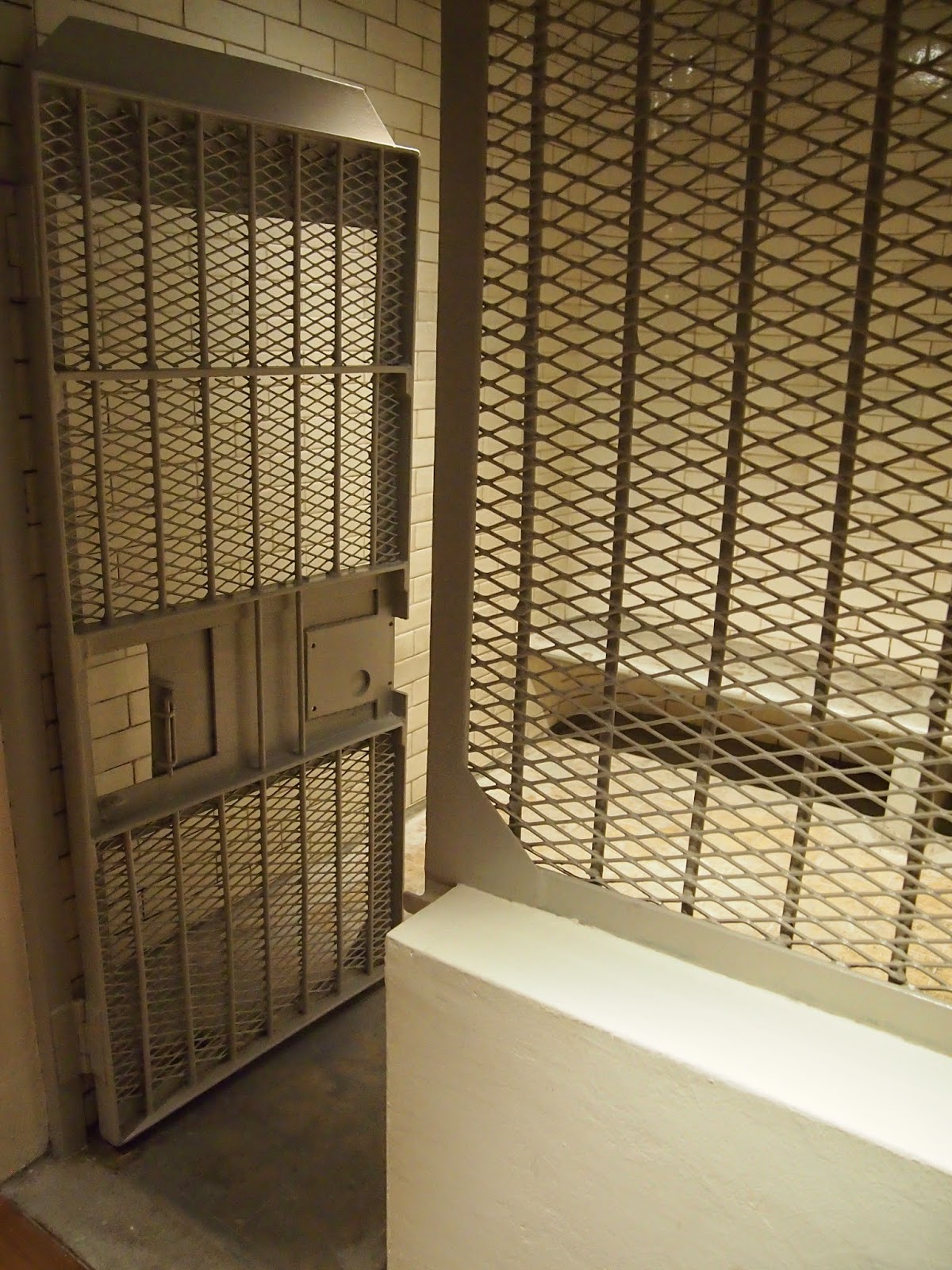
One of the lock-ups sited within the Supreme Court

It was a truly an eye-opener of an outing and meeting dedicated docents such as Sheila truly bring to life the rich history of the place.


References

1. Shetty, D.  April 24, 2015. National Gallery Singapore has Naked Museum tour. The Straits Times. http://www.straitstimes.com/lifestyle/visual-arts/story/national-gallery-singapore-has-naked-museum-tour-20150424#6 Accessed on May 2, 2015.

2. National Gallery Singapore. About the Buildings. http://www.nationalgallery.sg/buildings/ Accessed on May 2, 2015.

3. National Gallery Singapore. City Hall and Former Supreme Court at a glance. http://nationalartgallery.sg/wp-content/uploads/6_OpenHouse_Guided_Tour_Brochure_101110.pdf Accessed on May 2, 2015.

Sunday, April 26, 2015

Elgin Bridge: The Bridge That Separated The Malays From The Chinese

Elgin Bridge looking towards South Bridge Road

The site where Elgin Bridge sits was already a known crossing point before Sir Stamford Raffles landed in 1819. The locals had built themselves a wooden bridge that spanned over the Singapore river. (1) This bridge was significant as it was the only crossing to where the Chinese community lived. (2) The bridge also separated the Chinese (China town) from the Malays (Kampong Glam). (6)


Former Bridges before the construction of the Elgin Bridge

A closer view of the Elgin Bridge

The Elgin Bridge, named after Lord James Bruce Elgin, Governor-General of India was completed in May 30, 1929. (3) This is the fifth bridge that was built on this site. From the first locally-built wooden bridge, a new draw bridge was built by Lt. Philip Jackson in 1822. It was called the Presentment Bridge or Monkey Bridge. Workers were able to draw up the bridges whenever ships with tall sails made their way upstream towards the ports and godowns. (2)

In 1844, a wooden footbridge then replaced the old drawbridge. This new bridge was called Thomson Bridge, named after it's architect John Turnbull Thomson. The bridge was then replaced by an iron bridge in 1862 and it was then named Elgin Bridge. It was built at a cost of $13,000. When the old bridges were taken down in order to build the new bridges, it posed to the community great inconveniences as they would then have to use boats to move themselves and their goods to the other side of the river. (4)


Bridge lighting and emblem

Lights and plaques designed by Cavaliere Rudolfo Nolli

The bridge is not the only historically rich architecture. The cast iron orb lighting was designed by an Italian sculptor Cavaliere Rudolfo Nolli. (3) Other works by Nolli include sculptures in the former Supreme Court building, Raffles Hotel and King Edward VII College of medicine building.


Nolli also helped to design six bronze plaques - a lion standing in front of the palm tree - that welcome any visitors using the bridge on either side.


Looking down at the river 


It was such a throwback into time walking along the bridge. In those yesteryears, this pathway would be where people use it to get to the other side. No one would really stand along the walkway to watch the tongkangs go by. You see, Singapore River was no where near its current level of cleanliness. The water was filthy and sanitation was non-existent. Thus, the river became a filth pit of human excrement and waste. The river was deemed a "irreversible environmental disaster" by an UN expert. (6)

A tongkang bearing tourists moving towards Elgin Bridge

In the late 70s, the government pulled together the different ministries to look at how they could revitalise this polluted river. It took the inter-ministry team 10 years to change this environmental disaster to a miraculous success.

With such a transformation, both locals and tourists alike can now stop along Elgin Bridge to take in the history, watch the sunset and wave at people on board the electric-run tongkangs for tourists.   

Updated: February 10, 2016


References

1. History at four more places. June 29, 1985. The Straits Times. P13.

2. Keys, P. July 5, 1981. Spanning the river of life. The Straits Times. P24.

3. Cornellus-Takahama, V. Elgin Bridge. Accessed on April 26, 2015. http://eresources.nlb.gov.sg/infopedia/articles/SIP_921_2004-12-10.html

4. Untitled. October 5, 1861. The Straits Times. P15.

5. The Elgin Bridge is the fourth. December 7, 1954. The Singapore Free Press. P7.

6. Song, O. S. (1984). One Hundred Years' History of the Chinese in Singapore. London: Oxford University Press. P.8, 11.


Sunday, April 19, 2015

[Food] 328 Katong Laksa

328 Owner Ms Lucy Koh dictates her business at the entrance of her shop

With her well coiffed hair and neat dressing, Ms Lucy Koh easily stood out from the rest of her staff. She guards the front of her shop like a hawk and none of her staff was allowed close to her special formulated laksa gravy when she's around. No one except when she was away dishing out her laksa to Singaporeans in Shanghai, China every year during Singapore Day. (1)


Fresh cockles in the bowl of laksa

As I was visiting the shop under National Heritage Board's HeritageFest 2015, I did not have the opportunity to have a go at the laksa but was just happy to have the opportunity to speak with Ms Koh. (2)  But I was not deterred and had returned to the shop for dinner.

The crowd was just starting to build up when I was there at 10am

Ms Koh was quietly confident that she has one of the best laksa formula in town - her laksa won Gordon Ramsay's version hands-down. (3) This media savvy boss sees good online reviews of her laksa on sites such as Lonely Planet and ieatishootipost. (4) (5)

Previously, there were a number of pioneer laksa stalls in Katong. i.e. Janggut Laksa. But now, it looks like 328 Katong Laksa has now the monopoly of the laksa business there.

So how good is 328 Laksa? Is Janggut Laksa a worthy rival? (6)

Or maybe one that's outside of Katong - Sungei Road Laksa?

References

1. Singapore Day 2015 Shanghai. Accessed on April 18, 2015. https://www.singaporeday.sg/hawker.html

2. Heritagefest 2015. Accessed on April 18, 2015. http://heritagefest.sg

3. Hungrygowhere. Accessed on April 18, 2015. http://www.hungrygowhere.com/dining-guide/hawker/gordon-ramsay-wins-chilli-crab-loses-hawker-heroes-challenge-*aid-8b773f00/

4. 328 Katong Laksa. Lonely Planet. Accessed on April 18, 2015. http://www.lonelyplanet.com/singapore/restaurants/indonesian/328-katong-laksa

5. ieatishootipost. Accessed on April 18, 2015. http://ieatishootipost.sg/328-katong-laksa-hits-you-right-there-yeah-yeah-yeah/

6. Janggut Laksa: Original Katong Laksa.  http://singapore-trails.blogspot.sg/2014/11/janggut-laksa-original-katong-laksa.html

7. Sungei Road Laksa. http://singapore-trails.blogspot.sg/2014/09/sungei-road-original-laksa.html


Sunday, April 12, 2015

Senior Police Officers' Mess - Cloaked in Secrecy

Front view of the Officers' Mess

The Senior Police Officers' Mess sits deep in the heart of Mount Pleasant Road. The building itself - 153, Mount Pleasant Road - was said to have been built in the 1930s with the living quarters on the upper floor while the mess or the dining area was on the ground floor.  (1)


Looking from the right of the building

The Mess itself was manned by a small catering corp to prepare meals for these British Police Officers. There would also be parties every Friday nights where music and dancing was on the cards. (1)

But all parties ceased when the Japanese occupied Singapore in 1942. There were no records to show how this building was used by the Japanese. Currently, the building has been transformed into an Officers' Club and is being used to host both foreign and local dignitaries.

"Mr Wong Ah Sun, who has been a mess steward for 42 years, recalls making his way through the tapioca garden that is now the lawn and tennis courts and entering a Mess devoid of furnishings."  (1)

A cannon pointing outwards to protect the grounds

On the right of the building, I came across this huge cannon with a royal insignia embossed on it. I'm wondering if this was an original cannon placed there to guard the grounds and was it ever used used to fight the Japanese.

Different types of muskets and guns on display

Within the mess, there were also guns of different lengths on display. Other than the physical buildings and a remnants of guns and cannon, the ground was was pretty spartan. Also, I could not find much information about this place. It was as if the ground had wanted to withhold its secrets as it  refuses to speak.

Drop me a note if you have information about this particular building - 153 Mount Pleasant Road.

References

1.  Singapore Police Force. December 18, 2014. http://www.police.gov.sg/about/welfare/spom.html
Assessed on: April 11, 2015.  

Sunday, April 5, 2015

[Historical Site] Tanjong Pagar Railway Station - All Aboard


"I have not, the slightest doubt, that, for centuries, this Singapore terminal station will stand here as one of the most nodal points in the whole world's scheme of communications.' (1)

~ Sir Cecil Clementi, Governor of Singapore 

Confident words by Sir Clementi. The Train Station is no longer in use, but now stands as an important historical building that  in the past, help build up the economy of Singapore.

The Tanjong Pagar Train Station or what was listed in railway records as "Bukit Timah to Tanjong Pagar Deviation and New Terminal Station, Singapore' was officially opened by Sir Cecil Clementi on May 2, 1932. (2)

Over the years, the Train station witnessed the Japanese Occupation and their surrender. A Japanese officer committed suicide at the train station when Japan lost the war (4) ; the merger and separation of Singapore with Malaya, and finally, Singapore's own independence. As Singapore started to grow and prosper, the need of land became more critical.

Singapore and Malaysia started discussing about land swap which include the handing over of the Tanjong Pagar Railway Station since 1990. But disagreements on how both countries interpreted the Points of Agreement ensured that the land-swap was only agreed upon in 2010. The last train rolled out of the Tanjong Pagar Railway Station on July 1, 2011 and the building has been shuttered ever since, except on public holidays where the Singapore Land Authorities will throw open the gates to the public. (3) 

Here're pictures that I have taken on the Good Friday holiday.

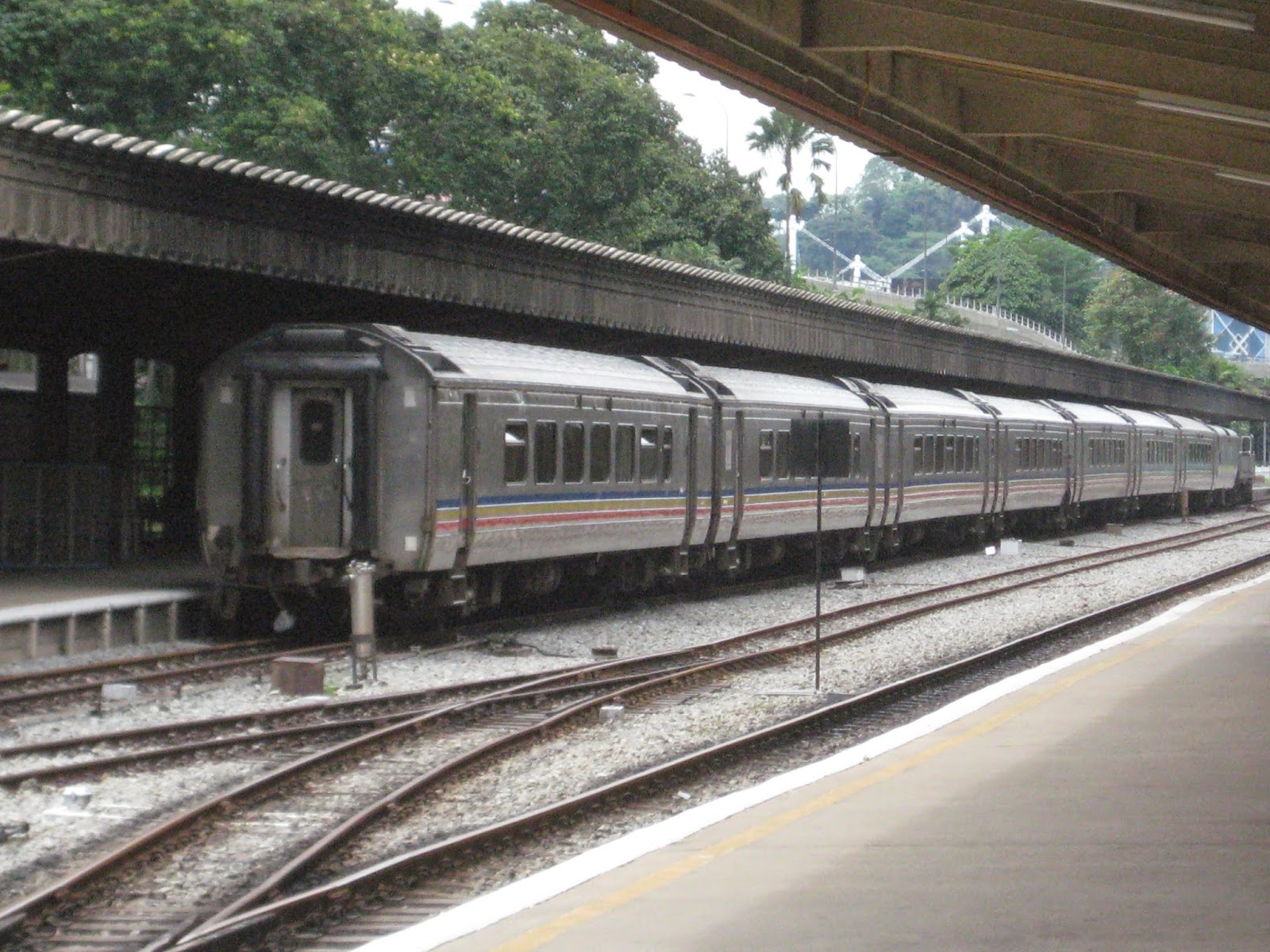
The sheltered platform where passengers waited for their train


A track that will no longer see any trains


Original Hydraulic buffers made in 1930

The external building reminding us of British buildings one would see in UK


References

1. "A Fine Engineering Achievement." May 3, 1932. The Straits Times. P12

2. Opening of Singapore's New Station. The Singapore Free Press and Mercantile Advertiser (1884-1942). May 3, 1932. P7.

3. Witnessing History Depart. July 11, 2011. The Straits Times. http://www.straitstimes.com/news/singapore/transport/story/witnessing-history-depart-20110711 Accessed on: April 4, 2015.

4. I saw Japanese soldiers torturing people in S'pore. July 14, 2013. New Straits Times. http://www.asiaone.com/print/News/Latest%2BNews/Singapore/Story/A1Story20130714-437043.html  Accessed on April 5, 2015.
Witnessing history depart

Witnessing history depart